
Lesson 2 — Scope Discipline: Drawing the Line
Module 3, Unit 2 | Lesson 2 of 3
By the end of this lesson, you will be able to:
- Explain why scope discipline is a governance issue in AI initiatives, not just a project management concern (K7, K24)
- Apply MoSCoW, SWOT, and the Iron Triangle to draw a defensible boundary around an AI initiative (K13, S3)
Why scope is more than a project plan
In a traditional IT project, scope is a list of features. In an AI initiative, it is something more consequential: a description of what the system is responsible for, what it leaves alone, and where the boundary of accountability runs.
That sounds abstract until you watch it fail in practice. An AI tool is built to triage one type of customer query. Three months in, a manager asks whether it could also screen complaints. The team agrees — it is the same model, after all. But screening complaints touches a different regulatory regime, a different population of users, and a different threshold for human review. The scope expanded informally. The governance did not.
This is the structural risk in AI work. Once a model exists, repurposing it is technically cheap. Capability scales faster than oversight. Scope discipline is the practice of refusing to let technical possibility quietly redefine organisational responsibility.
🔑 Key term: Scope creep — the gradual, often informal expansion of what an initiative is expected to deliver, beyond what was originally agreed. In AI projects, scope creep changes risk exposure as much as workload, because new processes, datasets, or user groups can pull the system into different legal, ethical, and oversight obligations.
Three techniques for drawing the line
You will not need all three of these on every project. They overlap deliberately. The point is to recognise which one is most useful for the question you are actually facing — prioritising features, stress-testing readiness, or negotiating trade-offs.
MoSCoW: prioritise by necessity
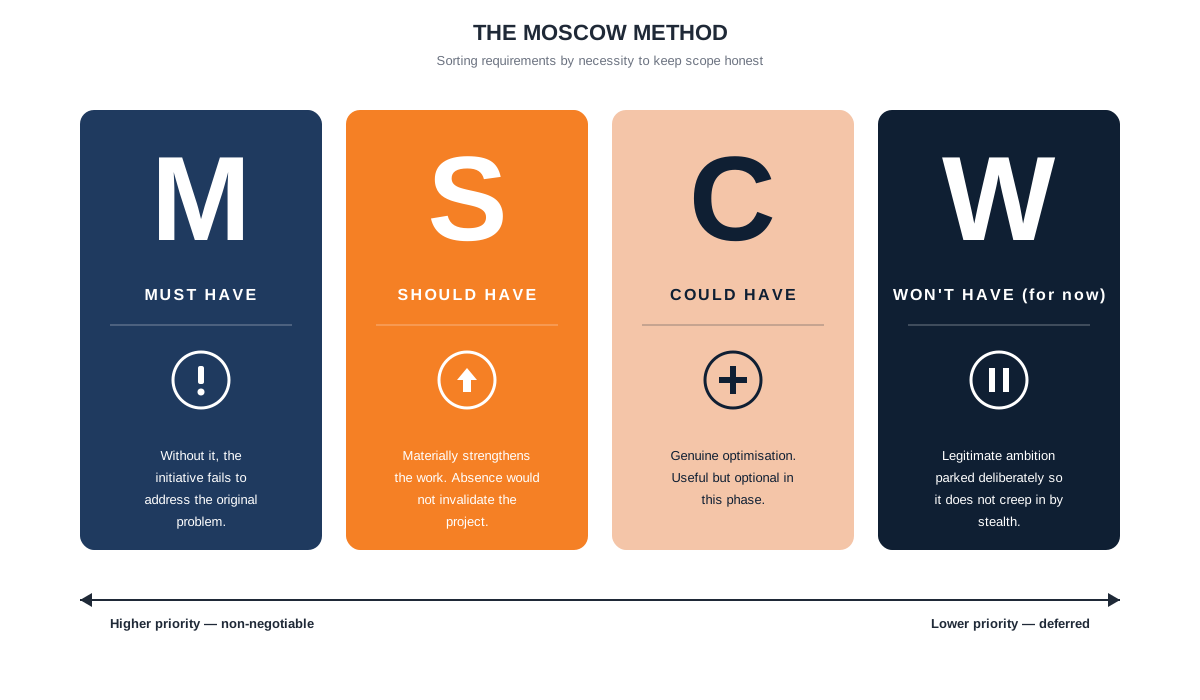
MoSCoW sorts requirements into four buckets: Must have, Should have, Could have, and Won't have for now. The discipline is not in inventing the categories; it is in being honest about which one each requirement actually belongs in.
A Must is something without which the initiative fails to address the original problem. If you can imagine the system delivering value without it, it is not a Must. Should materially strengthens the work but its absence would not invalidate the project. Could is genuine optimisation — useful, but optional. Won't have for now is the category most teams misuse: it is not a bin for bad ideas. It is a deliberate parking space for legitimate ambition that does not belong in this phase, kept visible so it does not creep in by stealth.
The most common MoSCoW failure is allowing too many items into the Must bucket. If everything is essential, nothing is — and the prioritisation has done no real work. A useful test: if the project had to ship in half the time, which Musts would you defend, and on what evidence? Anything that cannot survive that question probably belongs in Should.
Doing this with AI
Once you have a draft scope — MoSCoW list, SWOT, or Iron Triangle trade-off — paste it back to the model and ask: "Argue against each of my Musts. Then point out three places where this scope quietly expanded beyond the original problem." The model is reliably better at spotting scope drift than at avoiding it the first time round, and the challenge step is where the discipline actually happens.

SWOT: a realism test for the initiative
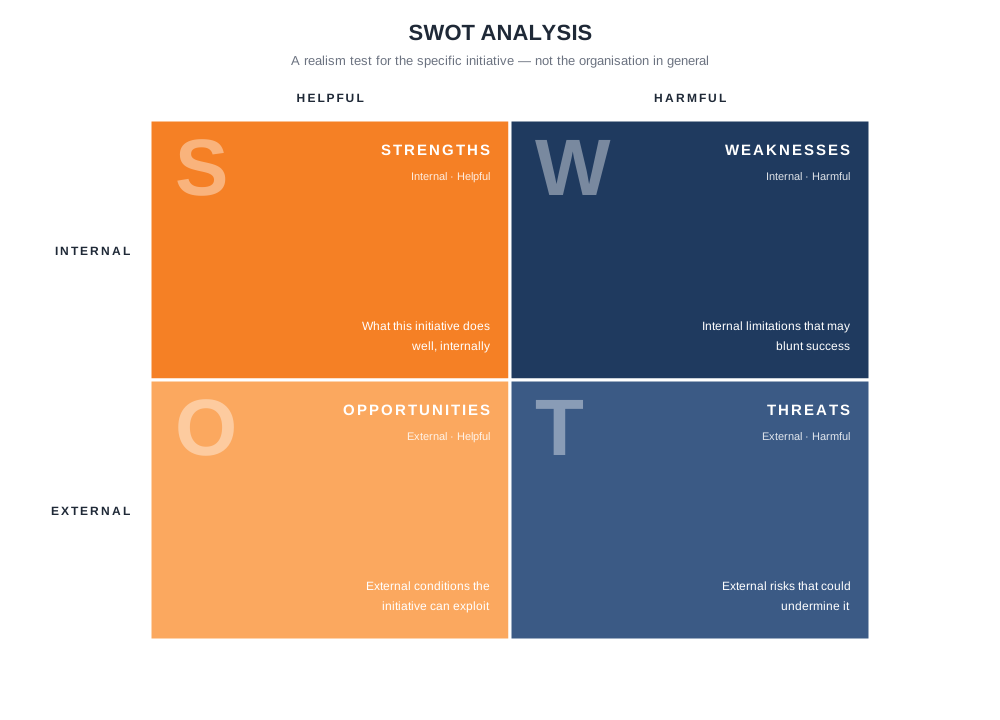
SWOT (Strengths, Weaknesses, Opportunities, Threats) is well-known, but in scope work it is used in a specific way: pointed at the initiative itself, not at the organisation in general.
The shift matters. An organisation can have strong AI capability overall and still be unready for a particular use case — because the data for this process is fragmented, or the workforce affected by this change has not been engaged, or the regulatory exposure of this deployment is unusually high. SWOT functions as a realism test for the specific intervention you are scoping: not "are we good at AI?" but "are we ready for this one?"
Implementation failures in AI are more often driven by organisational misalignment than by algorithmic weakness. A sophisticated model deployed into an unprepared operational environment remains fragile. SWOT, used honestly, makes that fragility visible early enough to do something about it.
The Iron Triangle: scope, time, cost
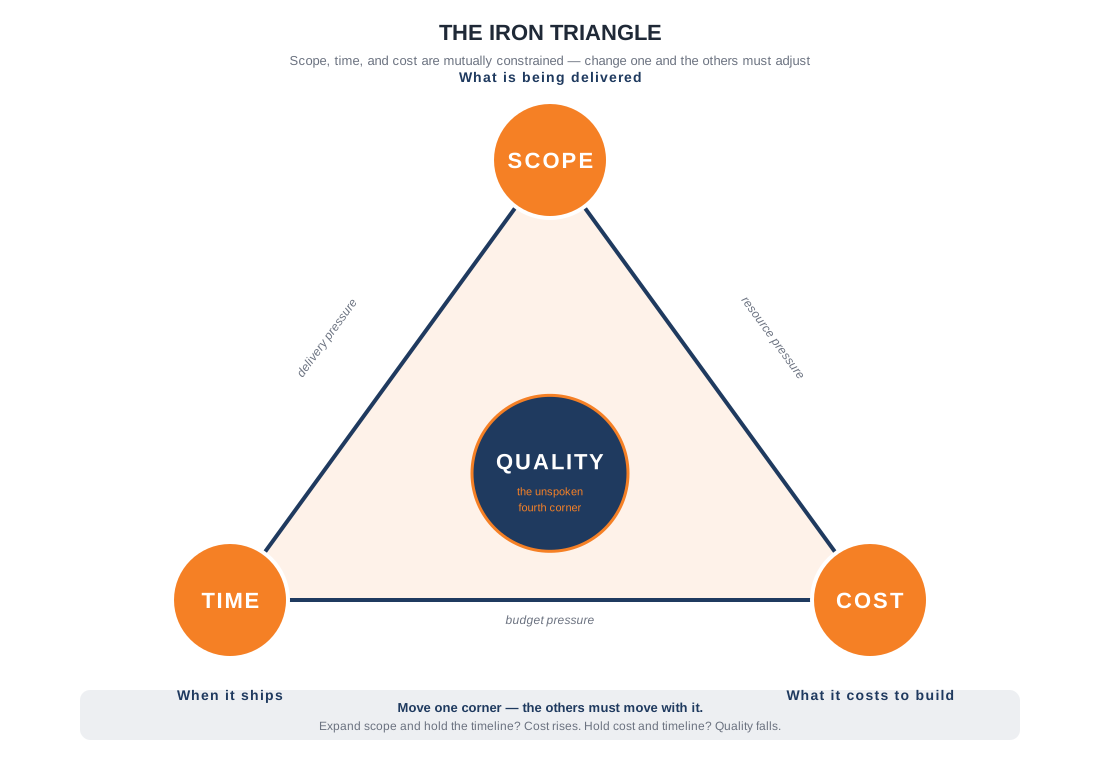
The Iron Triangle is the oldest of the three and the most useful in negotiations. It states something simple: scope, time, and cost are mutually constrained. Change one and the others must adjust. You cannot expand scope, hold the timeline, and keep the budget flat — at least not without sacrificing quality, which is the unspoken fourth corner.
In AI work the triangle is particularly easy to ignore, because the visible cost (a software licence, a developer's time) is usually the smallest part of the total. The full cost includes data preparation, integration, monitoring infrastructure, workforce training, change management, governance review, and ongoing maintenance — which over the lifetime of the system frequently exceeds the build cost.
The model is most valuable as a structured negotiation tool. When a sponsor asks "can we add this?", the right answer is rarely yes or no in isolation. It is: "yes, if the timeline moves by X weeks" or "yes, if we move these two items to Won't have for now." The Iron Triangle turns vague pressure into an explicit trade-off — and explicit trade-offs are far more likely to be made well than implicit ones.
💬 Reflection
Which of the three techniques fits your current project best? If you only have time to apply one this week, the most honest answer is usually whichever one your draft scope is least able to defend itself against. Pick that one.
Project Activity — Complete sections 3.1 and 3.2: scope and deliverables
Open the Module 3 Project workbook and complete section 3.1 Scope the project and section 3.2 Deliverables.
- Use MoSCoW to list Must, Should, Could, and Won't requirements. Treat the Won't column as seriously as the Must column.
- Complete the SWOT for this initiative in this organisation, not for AI in general.
- Use the Iron Triangle to state which constraint is fixed, which is flexible, and what that means for quality.
- Name at least three items that are out of scope and explain why excluding them protects the goal.
- Translate the scope into inspectable deliverables, each with a SMART description and accountable owner.
Project Checklist
- Section 3.1 has a complete MoSCoW list with evidence behind the Must items.
- My SWOT reflects my organisation's reality, including weaknesses and threats I would rather not discuss.
- My Iron Triangle choice is explicit about the trade-off I am accepting.
- I have named at least three out-of-scope items and explained the boundary.
- Section 3.2 turns the scope into concrete deliverables with SMART descriptions.
- Each deliverable has one accountable owner.
- The deliverables logically support the goal in section 2.3.

⏭️ Up next — Lesson 3: With problem, goals, and scope defined, Lesson 3 turns to how the work will actually be delivered. You will compare Agile, Waterfall, and Hybrid approaches as governance structures, and translate the chosen methodology into a roadmap, timeline, and the cadence the project will run on.