
Lesson 2 — Budget Analysis and ROI
Module 3, Unit 3 | Lesson 2 of 3
By the end of this lesson, you will be able to:
- Explain why budget analysis and ROI are governance instruments, not finance team paperwork (K7, K24)
- Construct a whole-life project budget that includes lifecycle, fixed/variable, and contingency components (K13, S3)
- Build a credible ROI model and stress-test it through scenario and sensitivity analysis (S4)
- Recognise the AI-specific failure modes — hidden lifecycle costs, time-savings that don't convert, optimism bias (B1, B2)
Why budget and ROI are governance instruments
By the time an initiative reaches this stage, two questions have already been answered: what problem is being solved, and how the work will be delivered. The remaining question is equally demanding: what will it cost, what value will it return, and how confident can the organisation be in those figures?
This is where budget analysis and Return on Investment move from being spreadsheet exercises to becoming instruments of governance. A weak budget undermines delivery before it begins. An inflated ROI model may win short-term approval but damages credibility once scrutiny begins. In well-run organisations, the financial case is not merely checked for arithmetic accuracy. It is examined for logic, completeness, realism, traceability, and proportionality.
Budget analysis determines whether the initiative has been costed honestly — whether the organisation understands the financial commitments required not only to build the solution, but also to govern, operate, monitor, and sustain it. ROI then asks whether expected benefits justify those commitments. Together, the two disciplines decide whether an initiative is economically sound rather than merely attractive in principle.
This matters particularly for AI and automation initiatives, which carry two predictable distortions. Costs are often understated — data preparation, integration, change support, training, monitoring, retraining, governance review, and risk controls are easy to leave off an early proposal. Benefits are often overstated — especially time savings, which are routinely assumed to convert automatically into financial value when in practice that conversion depends on whether released capacity is actually redeployed productively.
🔑 Key term: Whole-life cost — the full financial commitment created by an initiative across its entire lifecycle, from discovery and procurement through implementation, operation, monitoring, and eventual decommissioning. Whole-life costing is the standard required by HM Treasury appraisal guidance and is particularly important for AI systems, where post-deployment costs (monitoring, retraining, governance) often exceed build costs over time.
What a credible budget actually contains
A project budget is often misunderstood as a single number attached to a business case. In disciplined practice it is something more substantial: the financial expression of the delivery architecture. It shows what resources will be required, when, what assumptions sit beneath the estimates, and where uncertainty remains. A well-constructed budget makes the project's operational reality visible.
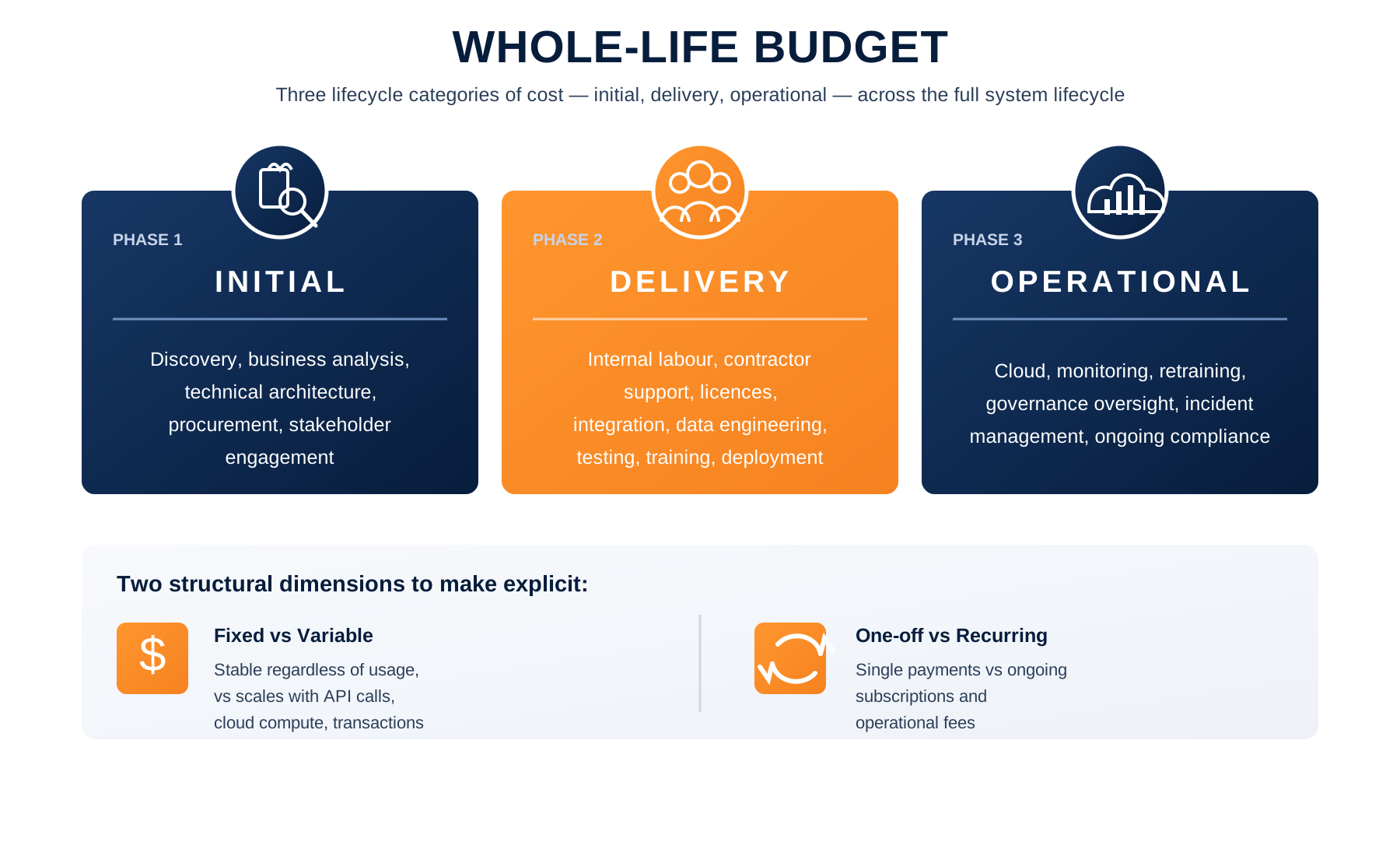
Three lifecycle categories belong in every credible AI budget.
Initial project costs cover the work done before implementation begins — discovery, business analysis, technical architecture, procurement, stakeholder engagement. In some organisations this work is being absorbed informally as staff time; budget analysis makes that effort visible rather than invisible.
Delivery and implementation costs cover the build itself — internal labour, contractor support, software licences, integration work, data engineering, testing, training, documentation, deployment preparation, and any specialist assurance or security review required before go-live.
Operational and sustaining costs are where weak budgets typically fail. For AI systems this includes cloud usage, third-party subscriptions, monitoring tooling, model evaluation, periodic retraining, governance oversight, support desk activity, incident management, and ongoing policy compliance. Omit these and the budget supports implementation but not responsible operation.
On top of these lifecycle categories, two structural distinctions matter for how the budget behaves.
Fixed versus variable. Fixed costs are stable regardless of usage — initial development, set licence fees. Variable costs change with scale — API calls, cloud compute, storage, support demand, transaction-based fees. The distinction matters because it tells you what happens to the budget when the initiative moves from pilot to scale. An initiative that looks affordable at pilot but is dominated by variable costs may become unaffordable at scale.
One-off versus recurring. A one-off integration fee may be fixed; a recurring cloud cost may be variable. Both dimensions need to be understood — sponsors making a one-time funding decision think differently from finance teams forecasting recurring spend.
Beyond categorisation, two practices separate budgets that hold from budgets that don't.
The first is explicit contingency. Contingency is not padding. It is an acknowledgement of uncertainty. If the project contains technical discovery, procurement risk, or dependency exposure, the budget should include a justified contingency amount or percentage. HM Treasury appraisal guidance is explicit on this point: uncertainty should be recognised, not hidden inside optimistic point estimates. Presenting fragile precision as financial discipline is one of the more reliable ways to lose sponsor confidence later.
The second is documented assumptions. If estimates depend on internal staff availability, on reuse of existing infrastructure, on a specific supplier pricing model, or on training being delivered in-house, those assumptions belong on the page. Assumptions are not footnotes. They are part of the financial logic of the proposal — and they are what gets revisited when something changes.
Return on Investment: what it is and what it isn't
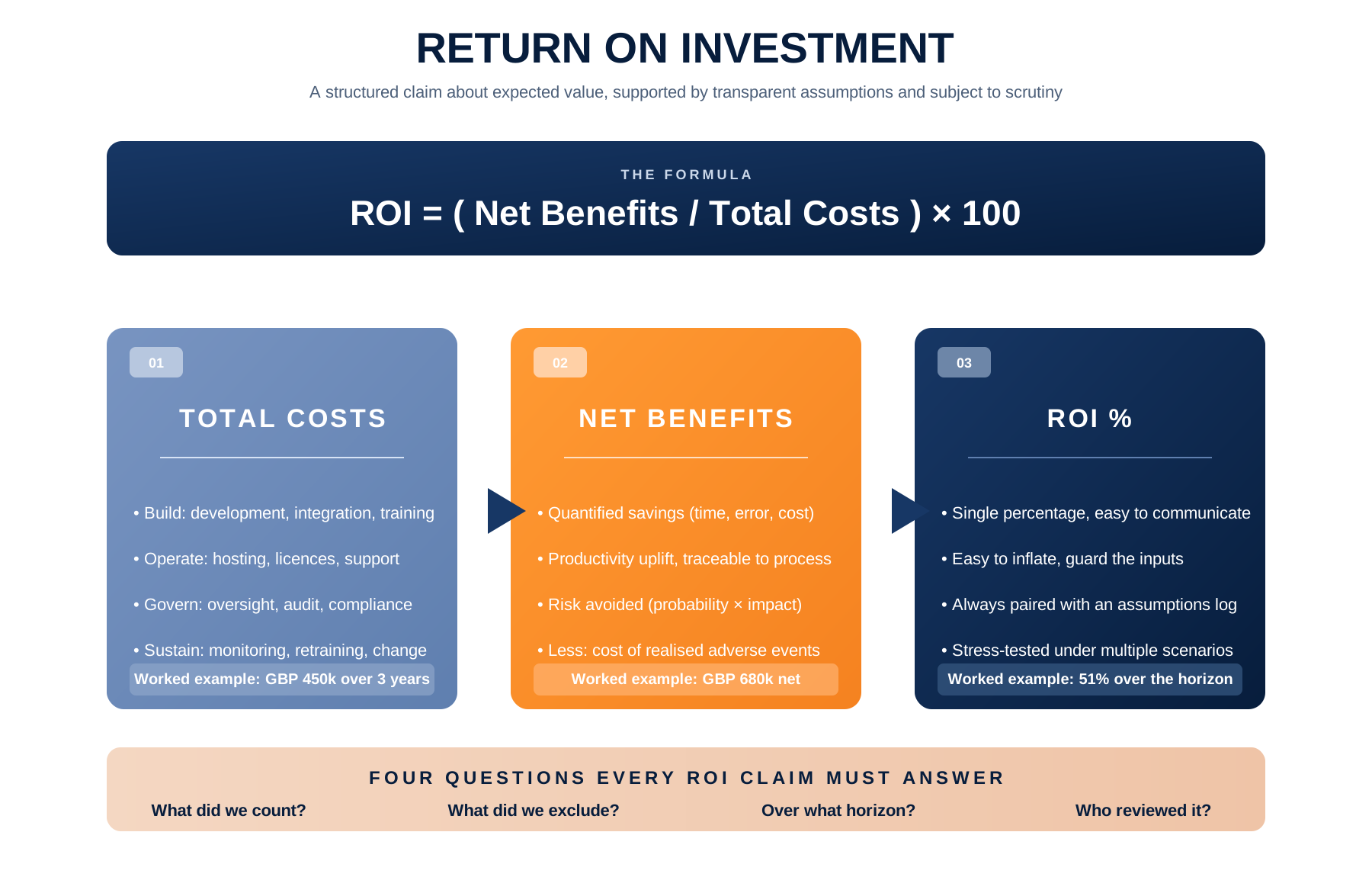
Return on Investment expresses the relationship between financial return and investment cost as a percentage:
ROI = (Net Benefits ÷ Total Costs) × 100
Where Net Benefits = Total Benefits − Total Costs. An initiative requiring £100,000 in total investment that generates £150,000 in financial benefit produces a net benefit of £50,000 and an ROI of 50%.
The arithmetic is simple. The interpretation is not. ROI is highly sensitive to the assumptions used to estimate costs and benefits — the time horizon, the method used to monetise operational improvements, and whether projected benefits are realistically achievable. A small change in any of those assumptions can move the ROI figure substantially.
ROI is therefore best understood not as a definitive prediction of value, but as a structured claim about expected value, supported by transparent assumptions and subject to critical scrutiny. Its widespread use in business cases reflects three real strengths. It supports investment prioritisation across competing initiatives. It forces discipline in benefit estimation — vague claims about "efficiency improvements" have to be translated into something concrete. And it provides communicative clarity for non-financial stakeholders.
Its risks mirror its strengths. Because ROI looks simple, it is easily inflated. Optimistic benefit projections, missing cost categories, and unstated assumptions all hide more easily inside an ROI figure than inside an NPV calculation. For AI and automation initiatives this is a recurring failure mode — proposals assume that efficiency gains automatically convert to cost savings, when in reality the conversion depends on whether staff capacity is genuinely redeployed, throughput actually increases, or errors and delays produce measurable financial losses.
A robust ROI model therefore demonstrates not only the expected return, but the logical pathway through which technological capability produces measurable economic value. That pathway is exactly what the next lesson on impact analysis covers.
Did you know?
ROI was popularised at DuPont in 1914 by F. Donaldson Brown, who decomposed return into the product of profit margin and asset turnover, what is now called the DuPont equation. When DuPont acquired a stake in General Motors in 1920, Brown was sent over to fix GM's near-collapse and used the same formula to bring its decentralised divisions under financial control. The metric now used to justify a 200k AI pilot is, structurally, the same one that saved General Motors a century ago.

Scenarios and sensitivity: testing whether the case still holds
Because projections are inherently uncertain, a single ROI figure is never the end of the analysis. Two practices stress-test the case.
Scenario modelling runs the ROI calculation under different sets of assumptions — typically a conservative case (cautious assumptions), a base case (most realistic expectations), and an optimistic case (favourable conditions). If the ROI remains positive across all three, confidence in the investment increases. If it only works in the optimistic case, the case is brittle and should not be presented as if it were robust.
Sensitivity analysis identifies which assumptions have the greatest influence on the result, then tests how changes in those assumptions affect ROI. In AI initiatives, the variables that move ROI most are usually adoption rate, system performance, and data quality — exactly the variables that are hardest to predict before deployment. Sensitivity testing tells decision-makers which assumptions need most evidence and which would, if they failed, sink the case.
This approach aligns with established investment appraisal practice, which emphasises transparency about uncertainty rather than reliance on a single deterministic forecast. A sponsor reviewing a single-figure ROI is being asked to trust the numbers. A sponsor reviewing scenario and sensitivity analysis is being shown the range of likely outcomes — which is a more honest, and more defensible, basis for an investment decision.
💬 Reflection
Of the assumptions in your draft ROI model, which one — if it turned out to be 30% worse than expected — would push the case from positive to negative? That assumption is the one your evidence and monitoring plan should focus on most. If you cannot identify a single most-sensitive assumption, the model probably doesn't yet have enough granularity to be tested seriously.
Linking budget and ROI
Budget analysis and ROI should never be treated as independent exercises. The credibility of an ROI calculation depends directly on the completeness and realism of the underlying budget. If the budget excludes critical cost categories — governance, monitoring, long-term maintenance — the ROI figure will be artificially inflated. Conversely, if projected benefits are exaggerated or poorly evidenced, the ROI will suggest value where none actually exists.
A credible financial case connects the two explicitly. Each major cost in the budget should correspond to a component of the delivery architecture; each projected benefit should link back to the measurable outcomes identified during impact analysis. When this connection is clear, the financial model becomes more than a spreadsheet — it becomes a coherent explanation of why the initiative is economically viable and operationally responsible.
Why this matters in AI and automation
Financial discipline matters in every project. It matters disproportionately in AI work because the relationship between technology investment and organisational value is consistently misunderstood.
On the cost side, building the model is rarely the most expensive part of the lifecycle. Significant resources are usually required for data preparation, integration, monitoring infrastructure, governance oversight, retraining cycles, and ongoing performance evaluation. Proposals that quote model build cost as the headline figure are routinely understating the true financial commitment by a factor of two or more.
On the benefit side, automation proposals frequently assume that time savings will translate directly into financial savings. In reality, value is only realised when operational improvements convert into measurable organisational outcomes — increased throughput, reduced external costs, redeployed staff capacity. If a process becomes faster but the freed time is absorbed by other low-value work, the operational benefit is real but the economic benefit is not.
Without disciplined financial analysis, these distortions produce investment cases that look attractive on paper but fail to deliver meaningful value in practice. A rigorous ROI model — connected to a whole-life budget, stress-tested through scenarios, and linked to a credible impact story — protects against that. In that sense, the ROI calculation is not just a financial exercise. It is evidence that the organisation has examined the initiative with the analytical rigour expected of responsible investment decisions.
Doing this with AI
The model is a useful adversary for an ROI case. Once you have a draft, ask: "You are a sceptical CFO. Identify three places where this ROI model would fail under questioning — overstated benefits, missing cost categories, or assumptions that depend on organisational changes nobody has planned. For each, suggest what evidence would be needed to defend it." The output is usually uncomfortably useful — and far better received before the actual sponsor meeting than after.

Project Activity — Complete section 4.4: budget analysis
Open the Module 3 Project workbook and complete section 4.4 Budget analysis. Treat the budget as a whole-life estimate, not a shopping list.
- Break costs into initial, delivery, and operational layers. Include discovery, procurement, build, integration, testing, training, deployment readiness, monitoring, retraining, governance, support, and incident management where relevant.
- Distinguish fixed from variable costs and one-off from recurring costs.
- Add contingency with a reasoned percentage or amount. Explain why that level of contingency is appropriate.
- List the three assumptions most likely to break the budget and how you would respond.
- Calculate headline ROI and show the inputs so a reviewer can challenge them.
Project Checklist
- Section 4.4 includes initial, delivery, and operational costs.
- Recurring AI costs such as monitoring, model evaluation, retraining, governance, and support are included where relevant.
- Costs are labelled fixed or variable, one-off or recurring.
- The contingency is justified, not added as a decorative percentage.
- The budget explains what changes when the project moves from pilot to production scale.
- ROI inputs are visible and traceable to evidence or assumptions.
- The three budget assumptions most likely to fail are named with response actions.
- The estimate avoids both optimism and hidden reserve: under-budget is treated as a planning failure too.

⏭️ Up next — Lesson 3: With the budget framed, Lesson 3 closes the financial picture. You will move from cost into value — Business Impact Analysis, Cost-Benefit Analysis, the financial evaluation metrics that test whether the case still holds under less optimistic assumptions, and how the impact pathway connects technology to measurable business outcomes.