
Lesson 3 — Pitching an AI Initiative
Module 3, Unit 1 | Lesson 3 of 3
By the end of this lesson, you will be able to:
- Structure an AI pitch using the Minto Pyramid (introduced in Unit 4 Lesson 3) — conclusion first, arguments grouped, evidence underneath (S3, S4)
- Produce both an executive one-pager and a longer pitch deck — each structured around the sections sponsors and risk reviewers will check first (S5, S15)
- Recognise and avoid the four AI-specific pitch failure modes — too technical, no risk discussion, vague metrics, no governance plan (B1, B2, B3)
Why the pitch is the part of an AI initiative that gets judged most often
Every AI initiative is pitched several times before it is delivered, and several more times during delivery. There is the initial sponsor pitch. The funding pitch. The risk-and-ethics gate pitches. The pitch to operational leaders whose teams will be affected. The pitch to legal and procurement. The pitch to the steering committee at each major milestone. Each of these is a moment where the project is judged against information the audience has not yet had time to read in full, by people whose default decision when uncertain is to delay.
The pitch is therefore not a marketing exercise. It is the compressed, defensible representation of all the work across the module, designed to survive the conditions under which it will actually be evaluated — short attention windows, mixed levels of technical literacy, a sceptical reviewer who has not been involved before, and a sponsor with three other initiatives to consider in the same hour. A pitch that has not been built for those conditions is a pitch that loses to better-prepared projects of lesser substance, which happens often.
This lesson is the synthesis lesson — it pulls together the structured work from earlier in the module and turns it into something that can stand up in front of a busy room. It does not introduce new analytical frameworks; it explains how the existing ones combine into a defensible pitch.
🔑 Key term: Pitch — a structured, time-bounded presentation of an initiative designed to support a decision. A pitch is not a status update, not a research paper, and not a celebration. It is built around the decision the audience has to make, and its quality is measured by whether the audience can make that decision well.
Structure: Minto applied to the AI pitch
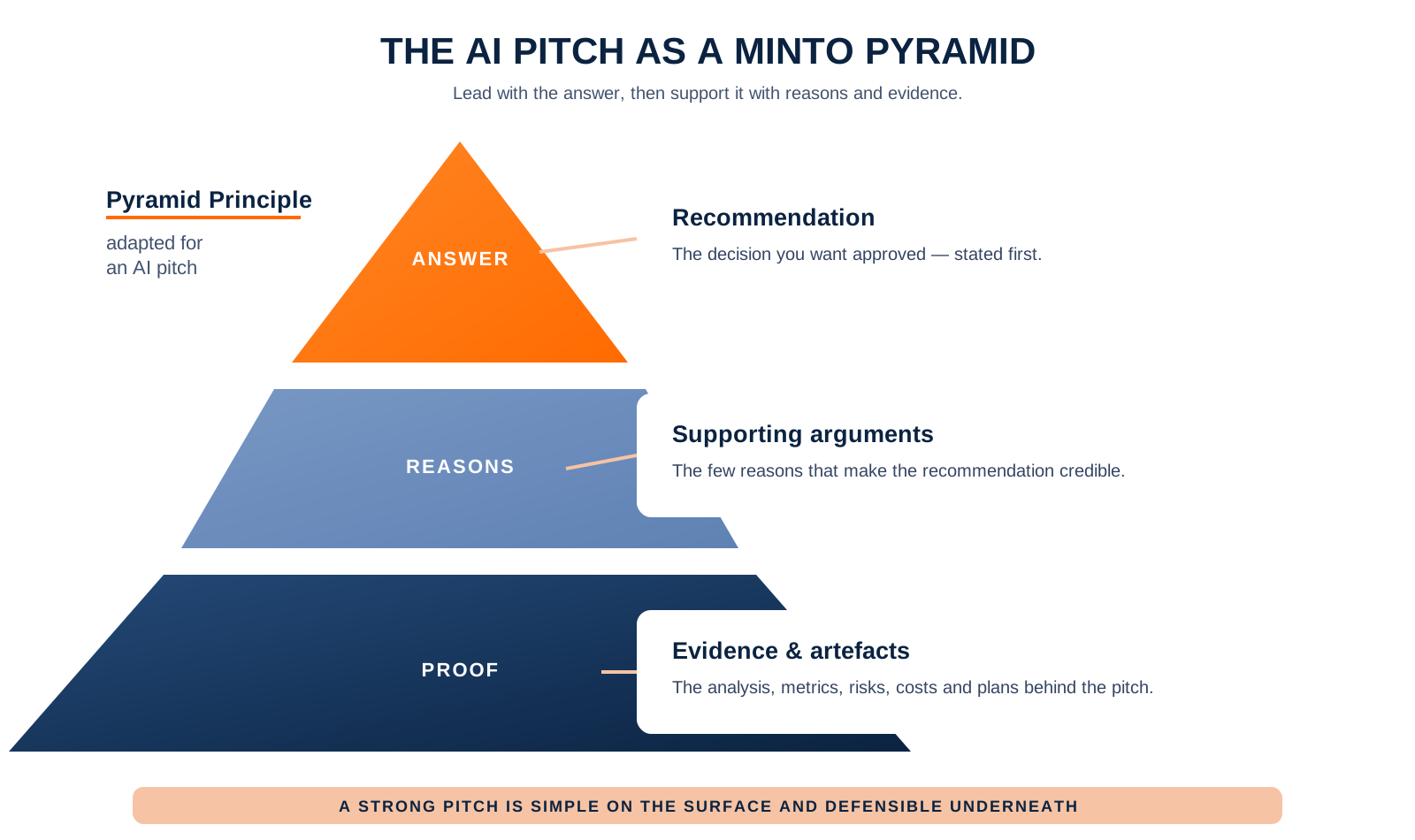
The Minto Pyramid (introduced in Unit 4 Lesson 3) is the right structural starting point for any AI pitch. The conclusion goes at the top — the recommendation, in one sentence, with the decision the audience is being asked to make. Beneath it sit two to four mutually exclusive supporting arguments. Beneath those sit the evidence: data, analysis, references back to the underlying work.
For an AI pitch, the conclusion sentence almost always has the same shape: "We recommend [decision] because [primary reason], achievable within [time and budget], with the risks managed by [governance approach]." That sentence is hard to write because it forces you to commit. It is also the sentence the audience will quote back to you in three months if they decide to proceed.
The three or four arguments beneath it should cover the four dimensions every reasonable AI sponsor will check:
The first argument is about the problem and the case for action. Why now? Why not next year? What does inaction cost? This argument lifts directly from your problem framing and root-cause work in Unit 1.
The second argument is about the solution and the value. Which archetype, why this one, and what is the value claim? This argument lifts from Lesson 2 (solution evaluation), Unit 3 L3.3 (impact analysis), and Unit 3 L3.2 (budget and ROI).
The third argument is about how delivery and risk will be governed. Methodology, milestones, the gates the project must pass, and the named accountability for each. This lifts from Unit 3 L3.1 (risk), Unit 2 L2.3 (delivery), and Unit 4 L4.1 (RACI).
The fourth argument, when needed, is about how the change will be absorbed. Who is affected, how will they be engaged, how will resistance be managed? This lifts from Unit 4 L4.1, L4.2, L4.3.
Underneath these four arguments sit the artefacts the pitch points to but does not display in full: the budget pack, the risk register, the stakeholder map, the goal statement, the solution evaluation. The pitch is the index into your work, not a substitute for it.
The pitch deck
When the audience expects a longer presentation — a steering committee, a major gate review, an investment committee — the deck version of the pitch typically runs eight to twelve slides. More than twelve and the deck stops being a pitch and becomes a report. Fewer than eight and the audience is being asked to evaluate too quickly.
A workable structure looks like this. Slide one is the recommendation, repeated from the one-pager — it is the slide that sets up the deck and the slide the audience returns to mentally throughout. Slides two and three cover the problem and the case for action, with one slide on the data and one on the human cost. Slide four is the proposed solution, with the archetype choice from Lesson 2 and the boundary of what is in scope. Slide five is the goal statement and metrics from Unit 2 L2.1, with the AI-specific commitments visible. Slides six and seven cover delivery and risk — the methodology, the milestones, and the top three risks with mitigations. Slide eight is the change and stakeholder picture from Unit 3. Slide nine is the financial case, including the headline ROI and the assumptions that drive it. Slide ten is the governance plan: the gates, the accountable people, and the decision rights. Slide eleven, when needed, is "what would change this recommendation" — the conditions that would lead the team to come back with different advice. Slide twelve is the closing ask, repeated.
A useful exercise when reviewing a draft deck is to ask: if the audience saw only slides one and twelve, would the deck still make sense? If the answer is no, the recommendation and the closing ask are not aligned tightly enough.
Four AI-specific pitch failure modes
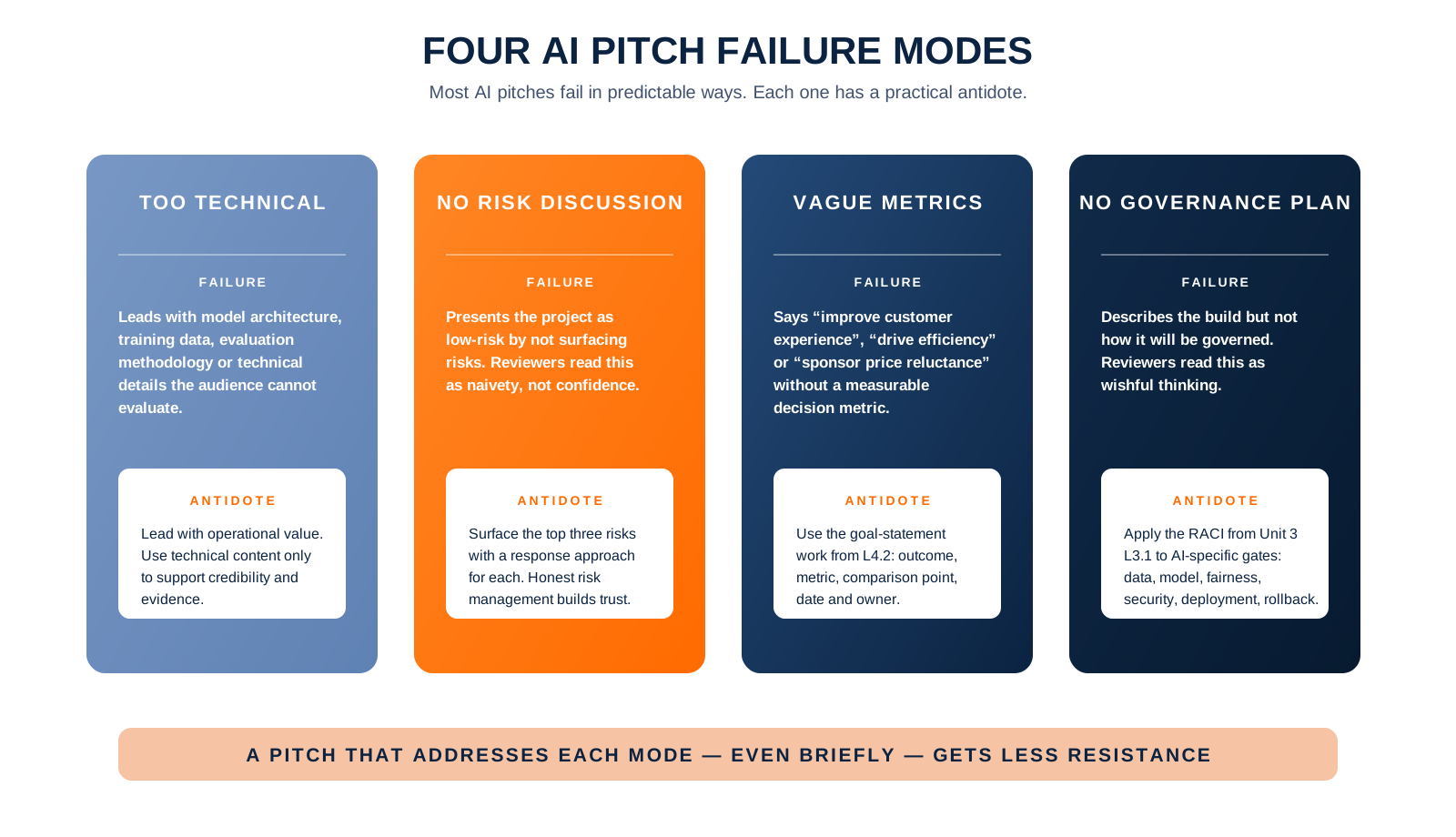
Most AI pitches fail in one of four predictable ways. They are worth naming because each one has a specific antidote.
The first failure is too technical. The pitch leads with model architecture, training data composition, evaluation methodology — content the audience cannot evaluate and therefore disengages from. The pitch then never recovers, because the moment the audience disengages is the moment the recommendation needs to land. The antidote is to put the technical content in the appendix, not the deck, and lead with the operational and value framing.
The second failure is no risk discussion. The pitch presents the project as low-risk because it does not surface the risks. Sceptical reviewers read this as naivety — they assume the team has not thought about the risks rather than that the risks are absent. The antidote is to surface the top three risks proactively, with the response approach for each. A pitch that surfaces risks honestly is consistently judged as more credible than one that hides them, even when the risk profile is identical.
The third failure is vague metrics. The pitch promises to "improve customer experience" or "drive efficiency" without committing to a measurable outcome. Sponsors interpret vague metrics as the team's reluctance to be held accountable, and they price that reluctance into their decision. The antidote is the goal-statement work from Unit 2 L2.1: an outcome metric, a comparison point, a date, and an accountable person.
The fourth failure is no governance plan. The pitch describes the build but not how the build will be governed — who decides each gate, how risk will be reviewed, what triggers a pause or a rollback. Risk and ethics reviewers read this as wishful thinking, and the project ends up bouncing between gates as governance is added retroactively. The antidote is the RACI from Unit 4 L4.1, applied to AI-specific gates: data access approval, model approach selection, fairness review, security review, deployment approval, rollback authority.
These four failure modes are not exotic. They are the patterns reviewers see week after week. A pitch that proactively addresses each one — even briefly — tends to receive less of the resistance that the failure modes are designed to provoke.
Did you know?
The original Apple iPod, launched in 2001, was internally called "5GB MP3 player" by Apple's marketing team — a name technically accurate and persuasively useless. Steve Jobs reframed the same product as "1,000 songs in your pocket". Same device, same storage, same audience. The reframing turned a hardware spec into something a customer could imagine using. Most AI pitches still lead with the equivalent of "5GB MP3 player" — the model architecture, the training data size, the integration count — when the version that lands describes what the system will do for the person who has to use it. The translation is rarely as elegant as Jobs's, but the discipline of attempting it is the difference between a pitch the room remembers and one it forgets.

Project Activity — Complete section 2.2: pitch the solution
Open the Module 3 Project workbook and complete section 2.2 Pitch a solution. The pitch should compress your problem framing and solution evaluation into a decision a sponsor could understand quickly.
- Write the one-paragraph pitch using this shape: We recommend [decision] because [primary reason], in [time/budget], with risks managed by [governance approach].
- Make sure the paragraph names the value, the boundary of the solution, and the next decision you need from the sponsor.
- Prepare three likely sponsor questions in a working note. Save them for section 6.2 Q&A preparation when you build the communication strategy.
- Check that every claim in the pitch points back to a portfolio section you have already started: Part 1 for the problem, 2.1 for the option choice, and 2.3 for the goal once it is drafted.
Project Checklist
- Section 2.2 contains a clear one-paragraph sponsor pitch of 4-6 sentences.
- The pitch begins with the recommendation, not background detail.
- The reason for the recommendation is connected to the problem and solution evaluation.
- The pitch includes time, budget, or delivery constraint language where known, and flags assumptions where unknown.
- The pitch names the governance or risk approach without turning into a technical explanation.
- I have captured three likely sponsor questions to reuse in section 6.2.
- The pitch acts as an index into the portfolio evidence, not a substitute for that evidence.

Unit 1 KSB summary
By the end of Unit 1, you can frame a business problem, evaluate the candidate solutions against the four AI archetypes, and pitch the chosen recommendation in a form that survives scrutiny.
Knowledge: K3 (problem framing), K4 (root cause analysis), K7 (structured solution evaluation), K13 (AI solution archetypes), K24 (decision frameworks for AI adoption)
Skills: S3 (analysing options), S4 (translating analysis into recommendations), S5 (structured pitching and persuasion), S15 (executive communication), S22 (decision documentation)
Behaviours: B1 (analytical rigour), B2 (intellectual honesty about uncertainty), B3 (recognising when 'don't build' is the right answer)
⏭️ Up next — Unit 2: Unit 1 has taken you from a defined problem, through a chosen solution, to a credible pitch. Unit 2 turns to the discipline of defining the project — writing goal statements that hold up, drawing scope boundaries that prevent drift, and choosing a delivery methodology that makes the work governable.