Lesson 2 — Change Implementation and Resistance Management
Module 3, Unit 4 | Lesson 2 of 3
By the end of this lesson, you will be able to:
- Distinguish change (the external event) from transition (the internal adjustment people have to make), and design implementation that takes both seriously (K7, K24)
- Diagnose where adoption is actually failing using ADKAR — awareness, desire, knowledge, ability, reinforcement — rather than treating all resistance as "communication" or "training" gaps (K13, S3, B1)
- Use Kotter's eight steps to plan the organisational momentum required for cross-functional AI initiatives, with explicit attention to short-term wins and barriers to action (S4)
- Anticipate the AI-specific resistance dynamics — fear of replacement, mistrust of model outputs, role redefinition for subject-matter experts — and build implementation that addresses them honestly rather than papering over them (B1, B2)
Why implementation is the part of an AI project that fails most often
A model can be technically excellent and an AI project can still fail. The literature on change management has been saying this for decades, and the AI delivery literature is now making the same point. The bottleneck is rarely the algorithm. It is whether the people whose work is being changed actually start working in the new way, and whether the organisation around them stops rewarding the old way.
This is uncomfortable for technical teams to absorb because it shifts the centre of gravity of the project. The hard work of building the model is what the team did; the hard work of making the model matter is what comes next, and it is mostly not technical. People resist change for reasons that are entirely rational from their own position: a new system threatens routines, expertise, autonomy, and sometimes employment. AI projects amplify all four. A model that automates triage is also, to the people doing the triage today, a redistribution of judgement away from them. Communication that does not acknowledge this reads as either complacent or dishonest.
Implementation planning therefore has to do two jobs at once. It has to address what is happening inside the people affected — their understanding, motivation, capability, and confidence. And it has to address what is happening across the organisation — leadership, structure, incentives, capability, and culture — because individual willingness collapses if the surrounding system still rewards the old behaviour.
🔑 Key term: Change vs transition — change is the external event (a new system, a new process, a reorganisation). Transition is the internal psychological adjustment people make to live with that event. Bridges' insight (1991) is that an organisation can implement change perfectly and still fail at transition, because transition runs on its own timeline and ignores project plans.
Two lenses, four frameworks
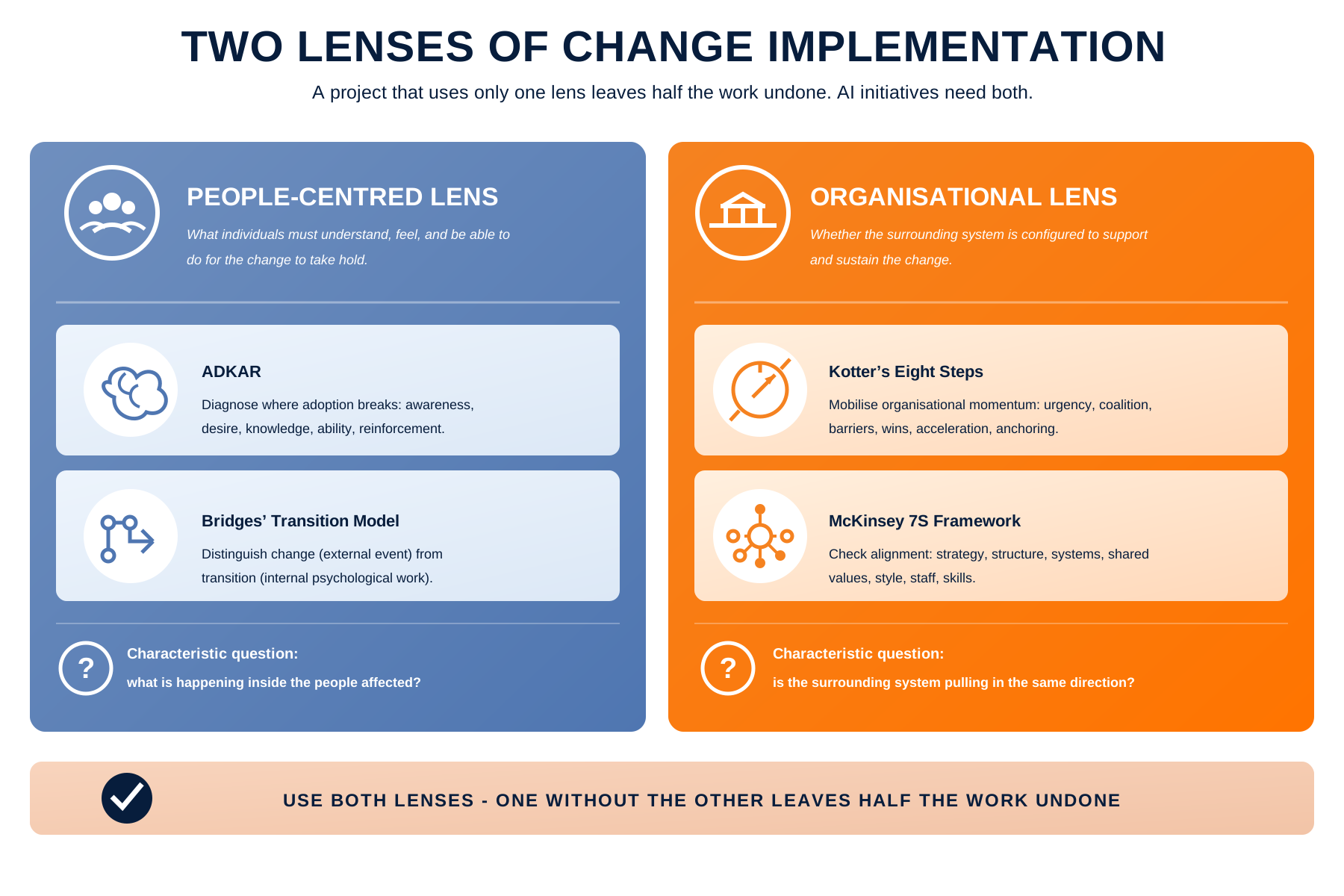
Implementation works through two complementary lenses. The people-centred lens asks what individuals must understand, feel, and be able to do for the change to take hold. ADKAR and Bridges' Transition Model sit on this lens. The organisational lens asks whether the surrounding system — leadership, structure, incentives, capability, culture — is configured to support the change. Kotter's Eight Steps and the McKinsey 7S Framework sit on this lens.
Most AI projects need both lenses. A project that uses only the people-centred lens may build excellent training and engagement and still fail because the organisation continues to reward the old way. A project that uses only the organisational lens may execute the rollout perfectly while leaving individuals confused, disengaged, or mistrustful of the system that is now making decisions about their work. The frameworks below are deliberately complementary.
ADKAR — diagnosing where adoption is actually breaking
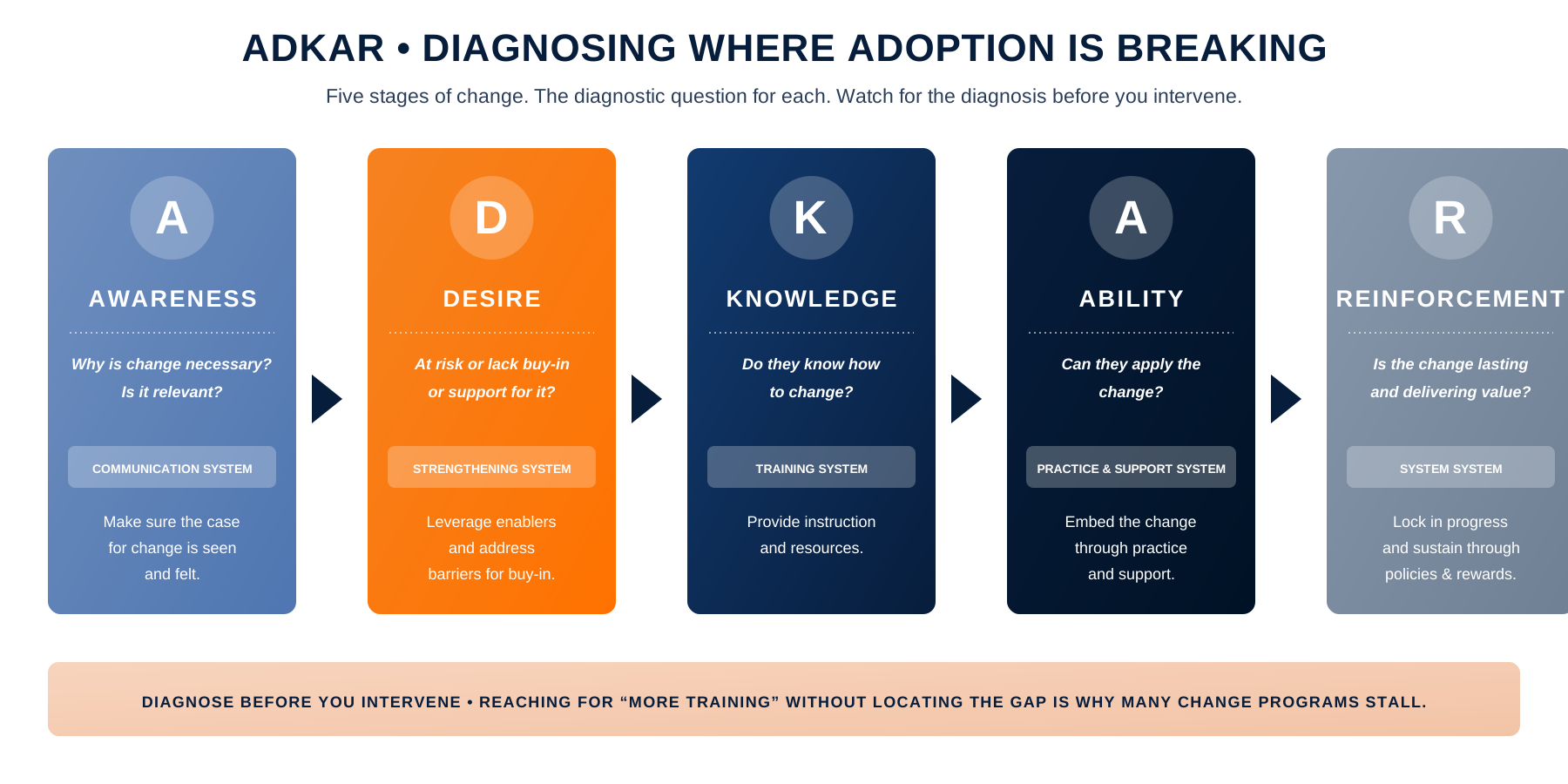
ADKAR (Hiatt, 2006) is a people-centred framework developed by Prosci that proposes adoption depends on five sequential elements: Awareness (do they understand why this is happening?), Desire (are they willing to engage with it?), Knowledge (do they know what to do differently?), Ability (can they actually do it in practice?), and Reinforcement (does the change stick after the project's attention fades?).
The framework's real strength is as a diagnostic rather than a checklist. When adoption is weak, the question is not "how do we communicate better?" — it is "which of the five is actually broken, and for whom?" The answer matters because the interventions are different. Low awareness is a case-for-change problem; the explanation has not landed. Low desire is a personal-stakes problem; people understand the rationale but do not feel it applies to them in a way they can support. Weak knowledge is a training problem. Weak ability is a practice and support problem — knowing what to do is different from being able to do it under operational pressure. Weak reinforcement is a system problem; the change has not been built into how the organisation rewards behaviour.
For AI projects, three diagnostic patterns recur and warrant explicit attention.
The first is knowledge without desire. People attend the training, can recite how the system works, and still do not use it. The training was the wrong intervention; the gap was in desire. Desire on AI projects is often connected to specific concerns: will using this make me look slower? will it make me responsible for the model's mistakes? will it lead to my role being downgraded? Until those concerns are surfaced and answered honestly, more knowledge will not fix the gap.
The second is awareness without trust. People understand the rationale, but they do not believe the model is good enough, or do not trust the team that built it. This often presents as low desire but is actually low awareness of the evidence — and the fix is not "more communication", it is exposure to the validation work, the failure modes, and the rollback plan. Subject-matter experts whose judgement the model is replacing are the audience most likely to land here, and they are the audience most likely to be dismissed as resistant when in fact they are asking the right questions.
The third is ability without reinforcement. People can do the new thing, do it for two months, and then drift back to the old way. The organisation has not built the change into management attention, performance measures, or escalation paths. AI projects are particularly vulnerable here because attention naturally drifts to the next initiative and the model is left to maintain itself, which models do not do.
The implication is that adoption problems should be diagnosed before they are intervened on. Reaching for "more communication" or "more training" without locating the actual breakdown is one of the most common change-management mistakes, and it produces busy projects that do not move the needle.
Doing this with AI
Once you have early evidence of resistance from a pilot — survey results, manager feedback, low usage metrics — paste it into the model with this prompt: "Here is what I am seeing. Diagnose where in ADKAR (awareness, desire, knowledge, ability, reinforcement) the actual breakdown is most likely sitting. For each element, list the specific evidence in this data that supports or contradicts that diagnosis. Recommend the lightest intervention that would test the diagnosis." The model is reliably useful at separating symptoms from causes — and "lightest intervention to test" is what stops the diagnosis turning into a busywork programme.
Bridges' Transition Model — the psychological side
Bridges (1991) draws a sharp distinction between change and transition. Change is what happens to the organisation: a new system, a new process, a new structure. Transition is what happens inside the people: the psychological work of letting go of the old way, surviving the period when the old is gone but the new does not yet feel stable, and eventually inhabiting the new.
The model has three phases. Endings, losing, letting go is the first — and Bridges' point is that you have to start there, even though project plans usually start with what is being introduced. Until people have processed what they are losing — autonomy, expertise, status, routine — they cannot fully engage with what is being introduced. The neutral zone is the middle phase, where the old way has weakened but the new way does not yet feel competent. It is uncomfortable, uneven, and full of mistakes that look like project failure but are actually the texture of transition. The new beginning is the third — when people start to inhabit the new way with confidence, identity, and a sense of purpose.
For AI projects, the most common failure is rushing the neutral zone. The model goes live, performance is uneven for the first six weeks because people are still finding their feet, and leadership reads this as evidence the system is broken. The system is not broken; the transition is incomplete. Treating the neutral zone as a managed phase — with extra coaching, visible leadership presence, temporary workload accommodation, and frequent feedback — is what allows the new beginning to actually arrive.
ADKAR and Bridges complement each other. ADKAR tells you what is breaking (which of five elements). Bridges tells you where in the transition arc people are. Used together, they distinguish between someone who has weak knowledge and someone who is in the middle of letting go of an old identity and is therefore not yet ready to absorb new knowledge.
Kotter's Eight Steps — building organisational momentum
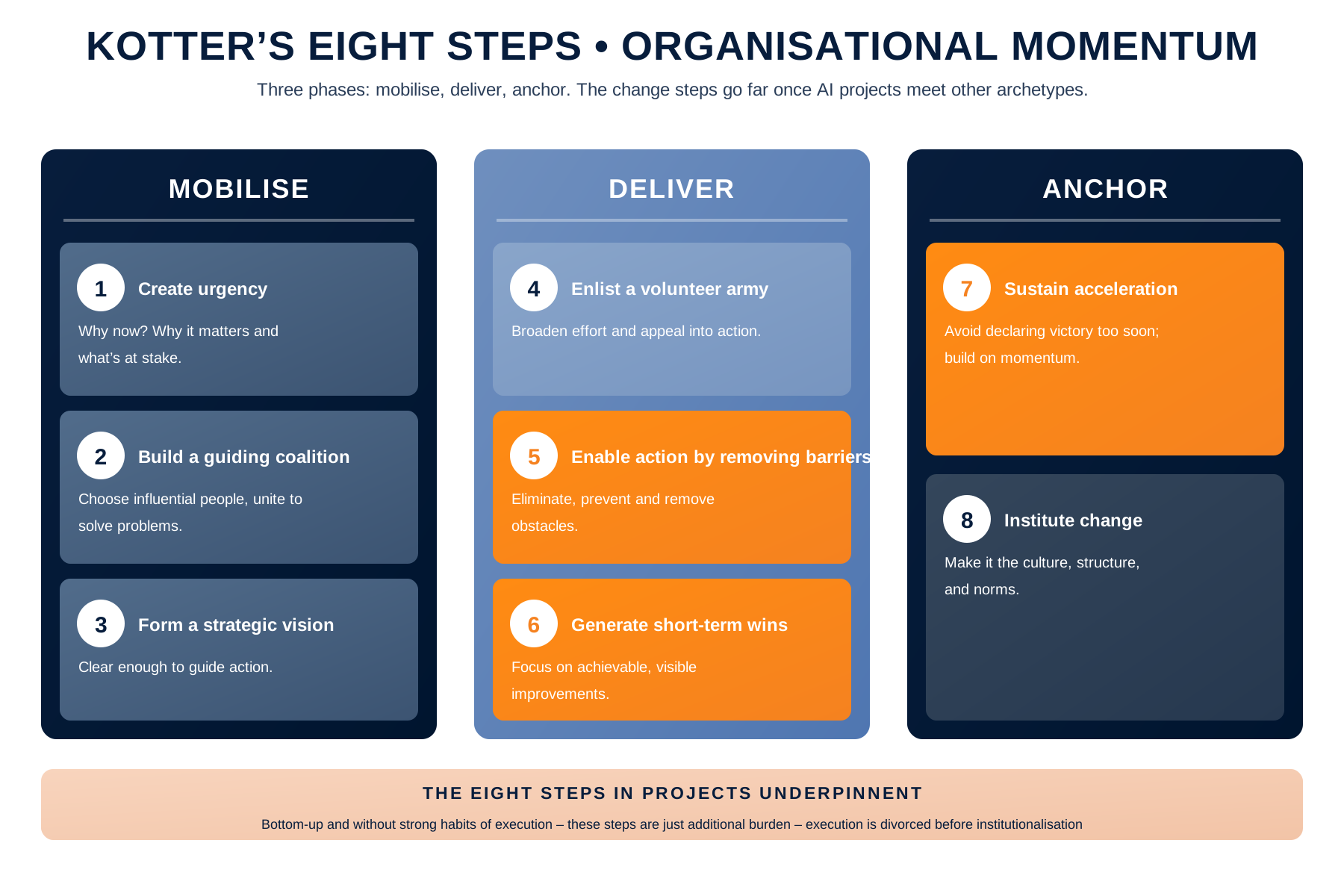
Kotter's framework (Kotter, 1996) addresses the organisational lens. It asks how change is mobilised across an organisation — how urgency is created, how a coalition of leaders is built, how barriers are removed, how early wins generate further momentum, and how the change is eventually built into the culture so it survives the project. The eight steps are: create urgency, build a guiding coalition, form a strategic vision, enlist a volunteer army, enable action by removing barriers, generate short-term wins, sustain acceleration, and institute change.
The framework is process-focused — it treats change as something an organisation has to push through itself, not just announce. For AI initiatives, three of the eight steps tend to receive less attention than they deserve and warrant explicit planning.
Removing barriers is the most often skipped step. Barriers on AI projects are typically structural: the data access process takes six weeks, the procurement function does not know how to evaluate model vendors, the HR function has no template for a role whose work will be partially automated. The project team often works around these barriers personally rather than removing them — which gets the project live but leaves the next AI initiative facing the same wall. Removing the barrier rather than working around it is what turns a successful project into organisational capability.
Short-term wins are not communications artefacts; they are evidence. A short-term win is something concrete enough for a sceptic to inspect: a measurable improvement on a real workload, in a place sceptics will recognise, achieved with the new way of working. AI projects often substitute announcements for wins — "we have completed integration", "training is on schedule" — which are project milestones, not wins. Sponsors notice the difference; sceptical operational stakeholders notice it more.
Sustaining acceleration is where most projects declare victory too early. Once early wins are visible, the temptation is to pivot the team and the budget to the next initiative. The change is not yet institutionalised at this point; it is fragile. Acceleration means using the credibility of the early wins to deepen adoption, address remaining barriers, and extend the change to the parts of the organisation where it is hardest. Skipping this step is what produces the pattern of AI initiatives that work in pilot and quietly disappear within a year of "successful" rollout.
Doing this with AI
Take a draft of your urgency case and paste it to the model with this prompt: "This is the case for change for an AI initiative. Identify the three weakest claims — points that a sceptical operational manager could push back on with evidence the project has not addressed. Suggest what would have to be true for each weak claim to become defensible." Pressure-testing your urgency case before sceptics do it for you is one of the highest-leverage uses of an LLM in change planning.
Did you know?
William Bridges, whose Transition Model is now standard in change management, was a professor of English literature at Mills College for fourteen years before he turned to organisational consulting in 1974. His framework — endings, the neutral zone, new beginnings — is structurally a rite-of-passage narrative borrowed from the literature he had been teaching. The three-phase arc of letting go, liminal disorientation, and reintegration is the same shape Joseph Campbell described as the hero's journey. Bridges was, in effect, applying narrative theory to organisational change. The framework that has guided thousands of corporate transformations was originally a literary structure with the names changed.

McKinsey 7S — the alignment check
The 7S Framework (Waterman, Peters and Phillips, 1980) takes a different view: rather than asking how to push change through, it asks whether the organisation is configured to absorb it. Seven elements need to be aligned for change to stick — three "harder" elements (strategy, structure, systems) and four "softer" ones (shared values, style, staff, skills). The framework's central claim is that change fails when these seven are pulling in different directions: a strategy that supports AI adoption combined with a structure that punishes cross-functional work, or systems that reinforce the old behaviour, or skills that have not been built.
For AI initiatives, 7S is most useful as a pre-rollout diagnostic. A pilot that succeeded in a contained environment may meet very different conditions at scale. The questions that surface most often are: Do staff have the skills to operate alongside the model competently? Do reporting lines and decision rights make sense for a process that now includes an AI step? Do incentive systems still reward the behaviour the model is supposed to displace? Does the leadership style being modelled match what the change requires?
Misalignment in any one of these can stall a project that is otherwise technically sound. The framework does not tell you what to do about the misalignment, but it tells you where to look — and looking before the rollout is significantly cheaper than discovering the misalignment afterwards.
Project Activity — Complete section 6.1: change management
Open the Module 3 Project workbook and complete section 6.1 Change management. Focus on the group most affected by the change, then show how the wider organisation will support the rollout.
- Use ADKAR to diagnose the likely adoption gap: awareness, desire, knowledge, ability, or reinforcement.
- Use Bridges' Transition Model to name what people are being asked to let go of, what the neutral zone will look like, and what leadership must do to make the new beginning credible.
- Use Kotter to plan the momentum: urgency, coalition, vision, barrier removal, short-term wins, acceleration, and anchoring.
- Use McKinsey 7S to identify the most likely organisational misalignment at rollout scale.
- Write the resistance summary: where resistance will come from, why, and how your plan addresses it without pretending it will disappear.
Project Checklist
- Section 6.1 identifies the stakeholder group most affected by the change.
- My ADKAR diagnosis distinguishes awareness, desire, knowledge, ability, and reinforcement.
- Bridges is used to name loss, uncertainty, and the leadership support needed for the new beginning.
- Kotter includes barrier removal, short-term wins as evidence, and sustaining acceleration.
- The 7S check names the single misalignment most likely to affect rollout.
- Resistance is described in organisationally specific terms, not as generic reluctance.
- The plan links back to the stakeholder, risk, and communication work already in the workbook.
- Short-term wins are inspectable evidence, not announcements.

⏭️ Up next — Lesson 3: With the change implementation plan in place, Lesson 3 turns to how that plan is actually communicated — the cadence, the message structure, and what makes the message persuasive to different audiences. Communication is the part of an AI project that fails most often, and the lesson that closes the module.