
Lesson 3 — Communication Strategy
Module 3, Unit 4 | Lesson 3 of 3
By the end of this lesson, you will be able to:
- Design a communication cadence that delivers different information at different rhythms to different stakeholders (K7, K24)
- Structure professional messages using the Minto Pyramid Principle, putting the conclusion first and the reasoning underneath (S3, S4)
- Match message design to audience motivation and ability — central-route arguments where stakeholders will engage in depth, peripheral-route framing where they will not (K13, B1)
- Apply ethos, pathos, and logos as a balance check rather than a rhetorical garnish, particularly when communicating about model uncertainty, fairness, and accountability (B1, B2)
Why communication is the fragile part of an AI project
Most AI projects fail not because the model is wrong but because the communication around the model is wrong. Sponsors approve a system whose behaviour they have not been told to expect. Operational staff hear about a new tool through a Slack announcement two weeks before launch. Risk reviewers see a fairness assessment for the first time in the gate meeting where they are expected to approve it. Customers experience a model decision and have no idea who to ask about it.
These are not technical failures. They are communication failures, and they tend to be worse on AI projects than on traditional IT projects for three reasons. First, AI systems behave probabilistically — the same input on Tuesday may produce a different output on Friday — and most organisations have no communication habit for explaining that. Second, AI redistributes judgement, which means the people whose work the model is changing are also the people most likely to mistrust it; communication has to address that mistrust without papering over it. Third, AI raises questions that ordinary IT does not — fairness, drift, accountability for an automated decision — and these questions tend to be ducked when the communication plan was built for a system upgrade.
A good communication strategy therefore does three things. It establishes a cadence so that information flows at the right rhythm to each audience. It structures messages so that the most important point lands first and the reasoning beneath it can be inspected. And it calibrates persuasion to how each audience will actually process the message — building credibility, addressing concerns, and presenting evidence in the right balance.
🔑 Key term: Communication strategy — the deliberate design of what is communicated, to whom, how often, in what structure, and with what persuasive emphasis. For AI projects, the strategy must also account for model uncertainty, drift, and the affective questions that automated decision-making raises.
Communication cadence — the rhythm of the project
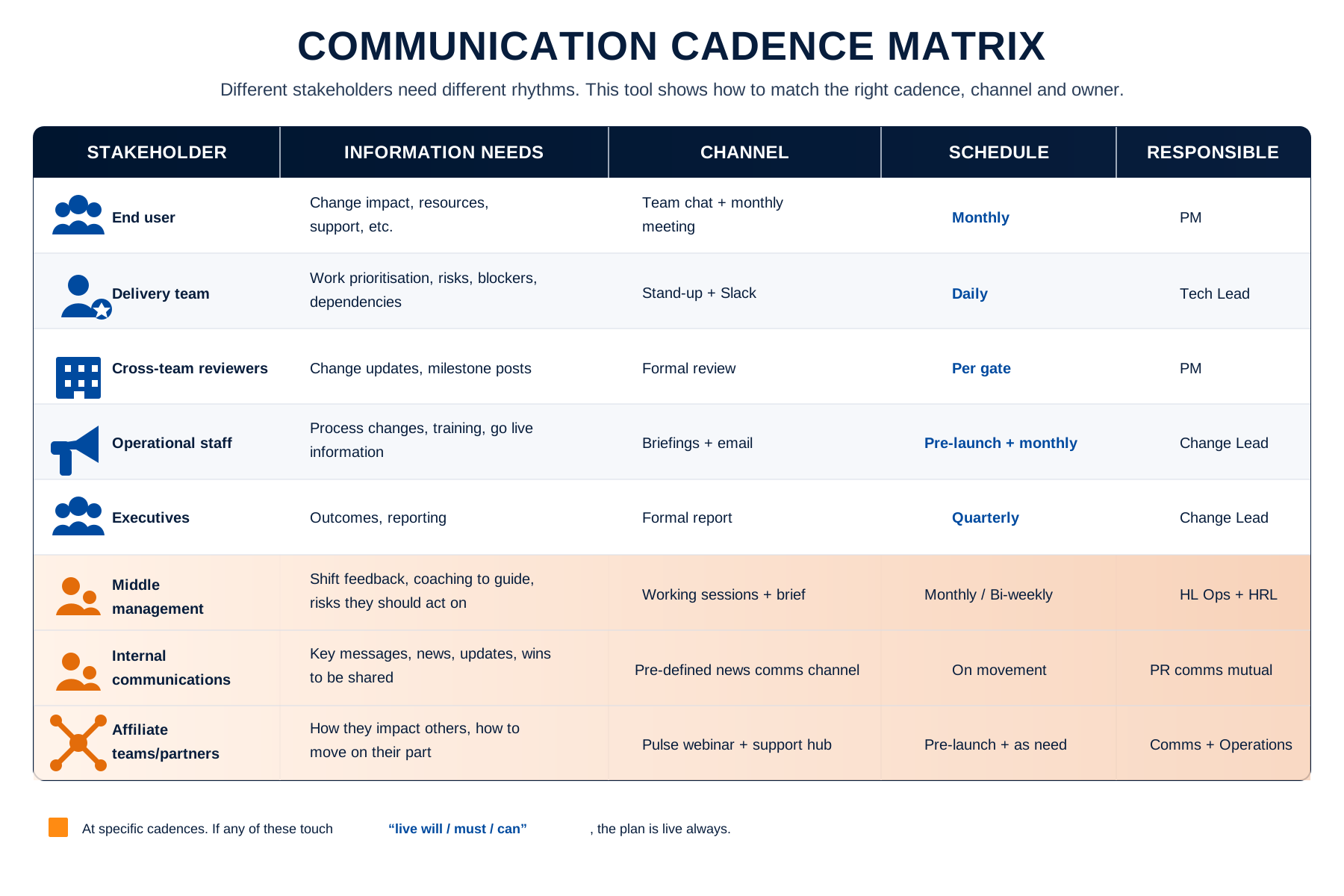
Communication cadence is the structured rhythm through which information flows between project teams and stakeholders. Without a cadence, communication tends to be reactive — updates appear when problems arise, which trains stakeholders to interpret silence as bad news. With a cadence, communication is predictable, which is itself a form of governance: stakeholders know when they will hear from you, what they will hear, and what they are expected to do with the information.
Cadence is normally captured in a communication matrix that answers five questions for each stakeholder group: Who is this audience? What information do they need? Through what channel? On what schedule? Who is responsible for delivering it?
Different stakeholders need different cadences. Executive sponsors typically want monthly strategic updates focused on milestones, risk, and budget — concise, written, and front-loaded with the conclusion. Delivery teams need daily or near-daily operational coordination through stand-ups and collaboration tools. Governance reviewers — risk, ethics, security, compliance — need formal review packs at defined gates, not constant updates. External stakeholders such as regulators may need monthly or quarterly compliance reports. End users affected by the system need periodic reassurance and honest information about what is changing.
For AI projects, three cadence design choices warrant special attention. The first is post-launch model communication. Once a model is in production, its behaviour will drift — performance changes as the underlying data distribution changes. The communication plan should include a recurring slot for model performance reporting: who reviews drift indicators, on what schedule, and who is told if something is degrading. Most AI projects forget this and end up communicating about the model only when something has gone wrong.
The second is incident communication. AI systems will produce wrong outputs, and stakeholders need to know in advance how that will be communicated when it happens. A communication cadence that has not pre-decided who tells whom about a model error will discover that on the wrong day.
The third is affected-party communication. If the model is making decisions that reach customers, applicants, or citizens, the cadence should include how those parties are told about the system, how they can raise an issue, and how the project will respond. This is increasingly a regulatory expectation, not a good-practice nicety.
Structuring the message: the Minto Pyramid
Most professional communication in organisations begins the wrong way round. The author starts with background, walks through the reasoning, and reaches the recommendation at the end. This feels intuitive when writing — it follows the order in which you developed the conclusion yourself — but it forces the reader to interpret the significance of every paragraph until they reach the punchline. Senior decision-makers do not have time for this, and the message often does not survive the journey.
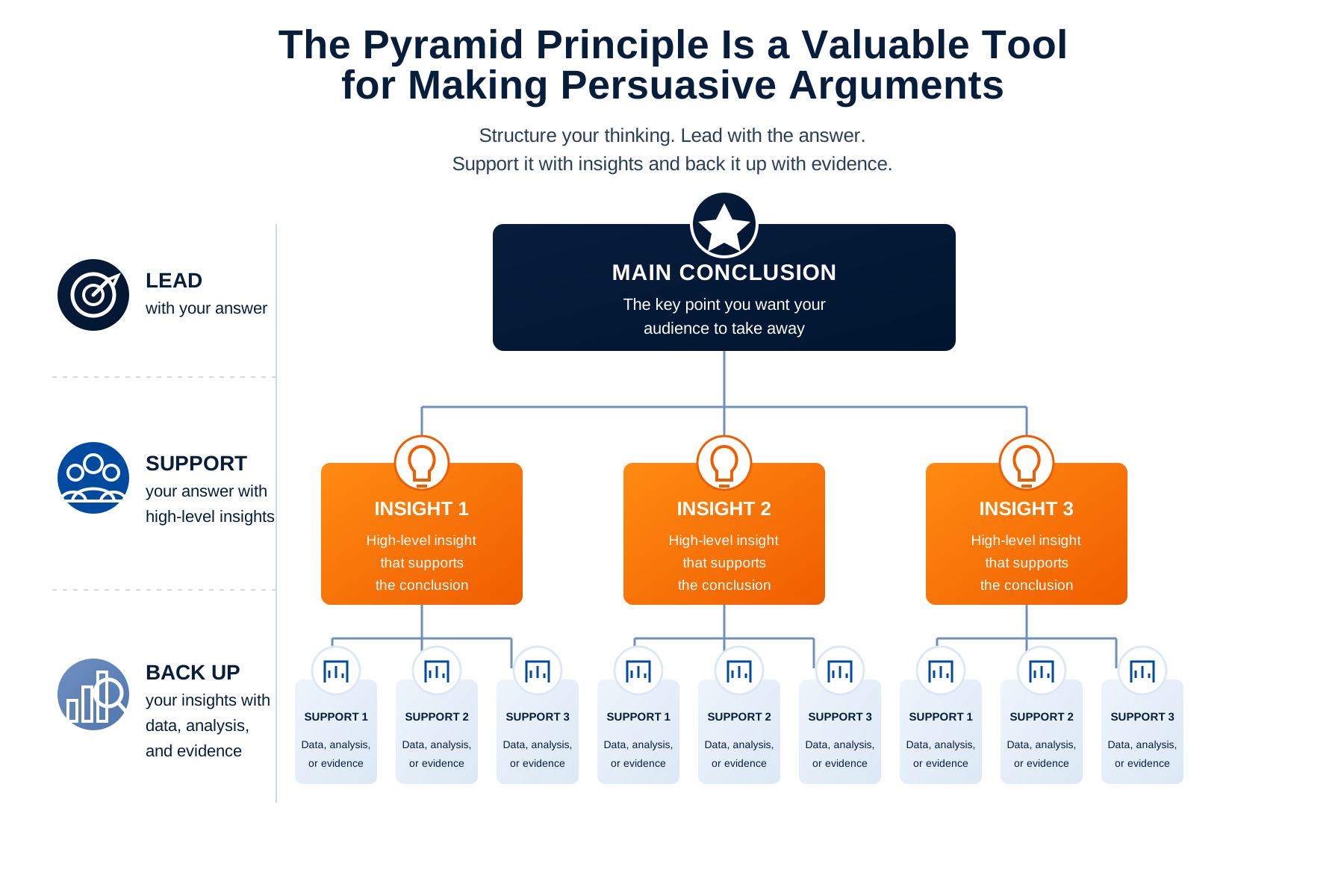
Barbara Minto's Pyramid Principle (Minto, 1987) inverts the structure. The most important idea — the conclusion or recommendation — sits at the top. Beneath it sit a small number of grouped, mutually exclusive supporting arguments. Beneath those sit the evidence and analysis that justify each argument. The reader sees the conclusion first, then can choose how deep to go.
A pyramid-structured project update for an AI initiative might begin: "The pilot has demonstrated that the model improves triage accuracy by 18% and we recommend proceeding to full rollout in Q3." That sentence is the top of the pyramid. Beneath it sit three supporting arguments — perhaps the accuracy gain is robust across stakeholder groups, the operational integration risks identified at scoping have been resolved, and the financial case from Unit 3 L3.2 still holds. Beneath each argument sits the evidence: the validation results, the integration test outcomes, the updated cost-benefit numbers.
The principle has two design rules that are easy to get wrong. The first is that supporting arguments should be MECE — mutually exclusive (no overlap) and collectively exhaustive (covering the full case for the conclusion). If the three arguments below your conclusion overlap, you are repeating yourself; if they leave gaps, you are giving the reader space to disagree. The second is that the conclusion should answer the actual question the audience is asking, not the question the project team has been thinking about. A sponsor asks "is this initiative still on track?", not "how is the team feeling about the data pipeline?" — and the top of the pyramid should answer the first question.
For AI projects specifically, the pyramid is most useful at three communication moments: gate review packs (where the conclusion should be the recommendation, not a status update), executive briefings (where stakeholders are time-constrained and will not read past the first paragraph), and incident reports (where the conclusion is what happened, what is being done, and what the recipient needs to do next — not a chronological narrative starting at "on Tuesday at 14:32").
Doing this with AI
Take a draft project update or report and paste it into the model with this prompt: "Restructure this as a Minto pyramid. State the single most important conclusion first in one sentence. List two or three mutually exclusive supporting arguments beneath it. Under each argument, list the specific evidence in this document that supports it. Flag any argument where the supporting evidence is thin." The model is excellent at this kind of structural compression — and the flagging step is what makes it useful, because it forces you to see where your reasoning is weak.

Did you know?
Barbara Minto joined McKinsey in 1963 as the firm's first female professional consultant, hired despite the partner who interviewed her noting in the file that he did not approve of women working. She developed the Pyramid Principle through the 1970s while running McKinsey's writing programme in London, where she had been sent partly because the New York office did not know what to do with her. The trigger was straightforward: the firm was producing reports that nobody could read. She self-published The Pyramid Principle in 1987 because mainstream publishers thought the topic was too narrow. It is now required reading at most consulting firms and a standard reference in MBA programmes worldwide.

Matching the message to the audience
A perfectly structured message can still fail if it is built for the wrong kind of audience. Petty and Cacioppo's Elaboration Likelihood Model (1986) explains why. They argue that people process persuasive messages through one of two routes. The central route is deep engagement: the audience evaluates arguments carefully, weighs evidence, and forms a considered view. Attitudes formed this way are stable and resistant to change. The peripheral route is shortcut processing: the audience relies on cues — credibility of the speaker, simplicity of the message, emotional tone, perceived authority — rather than analysing the argument in detail. Attitudes formed this way are quicker but more fragile.
Which route an audience uses depends on two factors: motivation (do they care enough about this issue to engage deeply?) and ability (do they have the knowledge, time, and cognitive bandwidth to evaluate the argument?). High motivation plus high ability tends to produce central-route processing. Low on either dimension tends to produce peripheral-route processing.
The practical implication is straightforward: design the message for the route the audience will actually use, not the route you wish they would use. A model-validation pack written for a fairness reviewer with high motivation and high ability should rely on robust evidence and explicit reasoning — central-route content. The same content sent to an executive sponsor who has 90 seconds before their next meeting will not work, because the conditions for central-route processing are not met. The executive version needs a different structure: a credible source, a clear summary, a recognisable framing, and a route in for the reviewer to go deeper if they want.
The route also shifts as the project moves. At pilot, technical stakeholders engage centrally; at rollout, the audience widens to operational and affected stakeholders, many of whom will engage peripherally. Communication that worked in pilot stops working in rollout, and the team that does not notice will find that "we already explained this" stops being a defence.
Ethos, Pathos, Logos — the balance check
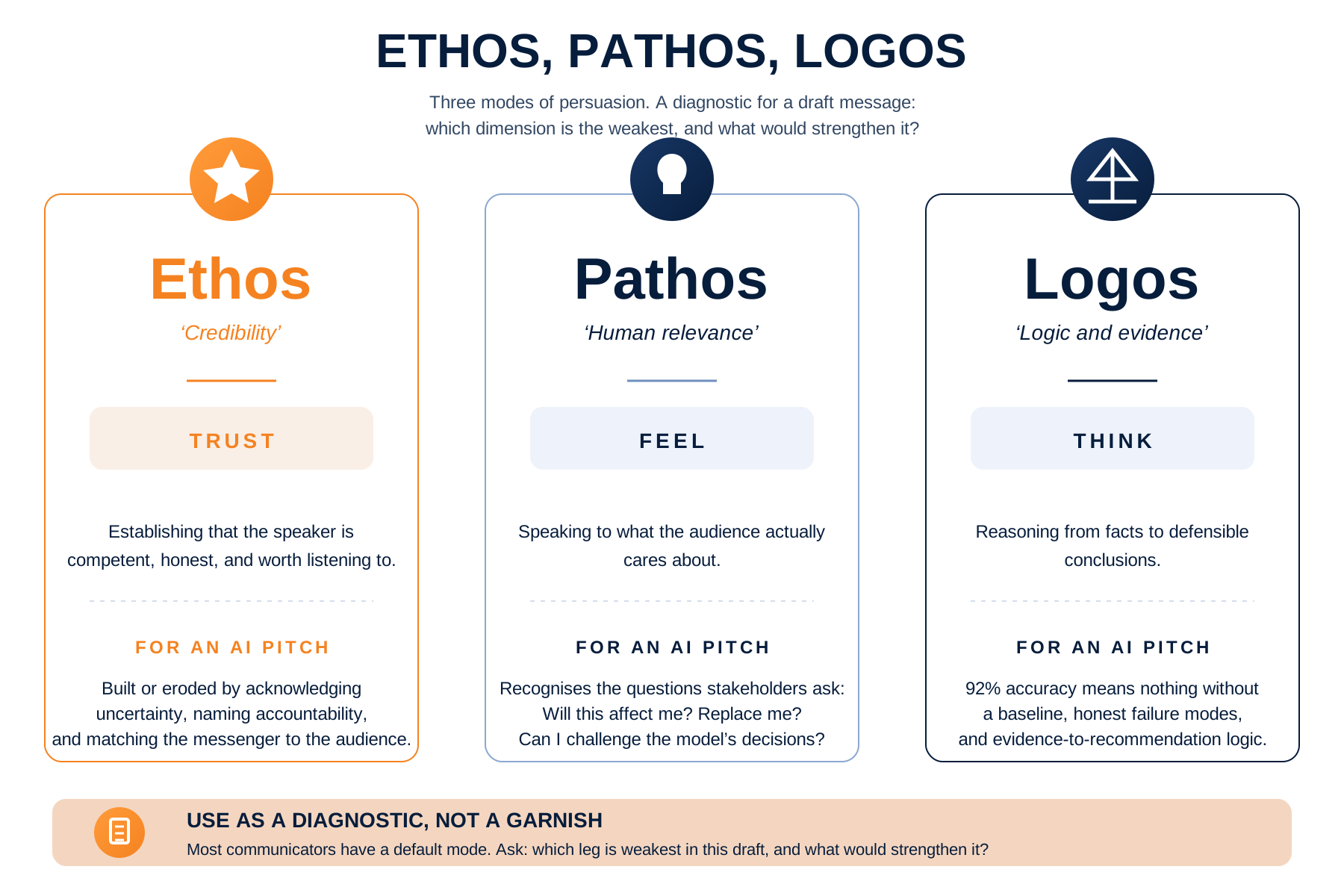
Aristotle's three modes of persuasion — ethos (credibility), pathos (emotional and human relevance), and logos (logic and evidence) — are roughly 2,400 years old, but they remain the most useful balance check for any professional message because they describe three different ways an argument can fail.
A message can fail on ethos when the audience does not trust the speaker. For an AI project, ethos is built or eroded through specific behaviours: acknowledging uncertainty in model performance rather than overselling, being consistent about what the system does and does not do, naming the people accountable for each gate, and putting the right messenger in front of each audience. A senior data scientist explaining a fairness assessment will land differently than the same words from the project manager — not because one is more correct, but because the audience is using the messenger as a credibility cue.
A message can fail on pathos when it ignores what the audience actually cares about. For AI projects, the human concerns are usually some combination of will this make my work harder, will it replace me, will it make decisions about me that I cannot challenge, and can I trust what it produces? These are real concerns, and a message that does not acknowledge them lands as either complacent or dismissive. Pathos done well is not emotional manipulation — it is recognition that the audience is processing the project through these questions whether the communicator addresses them or not.
A message can fail on logos when the reasoning does not hold. AI projects are particularly vulnerable here because the evidence is often statistical and easy to misrepresent. "The model is 92% accurate" sounds strong but is meaningless without a baseline, a confusion matrix, and a description of what the wrong 8% actually does. Strong logos for an AI initiative includes: an explicit baseline (what is the alternative?), an honest account of failure modes, sensitivity to assumption (what would change the conclusion?), and a clear chain from evidence to recommendation.
The framework's real value is as a diagnostic for one's own messaging. Most communicators have a default mode — technical leads tend to over-rely on logos, change leaders on pathos, executives on ethos. The default usually works well for some audiences and fails for others. Asking which of the three is weakest in this draft? is one of the most effective revisions any communicator can run.
For AI initiatives specifically, all three are non-optional. Stakeholders need to trust the people leading the change (ethos), see that their concerns are taken seriously (pathos), and have access to evidence that can withstand scrutiny (logos). A message that leans on only one of these will eventually meet an audience that needs the other two.
Doing this with AI
Once you have a draft message for a specific audience, paste it into the model with this prompt: "Score this message from 1 to 5 on each of ethos, pathos, and logos, given that the audience is X. For the lowest-scoring dimension, write three concrete revisions that would strengthen it without exaggerating, manipulating, or padding the message." Forcing the model to identify the weakest leg and propose specific fixes is more useful than asking it to "improve" the message — vague improvement requests produce verbose drafts; targeted balance fixes produce sharper ones.
Project Activity — Complete section 6.2 and Part 7: communication, reflection, and submission
Open the Module 3 Project workbook and complete section 6.2 Communication and Part 7 Reflection. This is the point where the portfolio becomes one coherent recommendation rather than a set of separate analyses.
- Complete the communication cadence matrix for every stakeholder group from your map, including model performance reporting, incident communication, and affected-party communication.
- Build the Minto pyramid for the pitch: conclusion first, then two to four supporting arguments with evidence.
- Run an ethos-pathos-logos check on your most important communication and revise the weakest dimension.
- Complete the Q&A preparation using the hardest questions you collected in Lesson 1.3 and any new questions raised by risk, budget, governance, and change planning.
- Complete Part 7: implementation sequence, critical overview, recommendations, references, and the submission checklist.
Project Checklist
- Section 6.2 covers all stakeholder groups from the stakeholder map.
- Communication cadence includes project updates, model performance reporting, incident communication, and affected-party communication where relevant.
- The Minto pyramid starts with the decision or recommendation the audience needs to hear.
- Ethos, pathos, and logos have been checked against the real audience, not a generic audience.
- The Q&A preparation includes the hardest questions from problem framing, solution choice, risk, budget, governance, and change.
- Part 7 explains the implementation sequence from approval to go-live with decision gates and evidence.
- The critical overview names the strongest section, weakest section, exposed assumptions, and what I would change.
- The closing recommendation is clear: proceed, proceed with modifications, pause, or do not proceed.
- References are listed, and every important numerical claim or external evidence point is traceable.
- The submission checklist has been reviewed before the workbook is handed in.

Unit 4 KSB summary
By the end of Unit 4, you can map stakeholders for an AI initiative, plan the change required to make it land, and design a communication strategy that holds up across audiences with very different priorities.
Knowledge: K3 (stakeholder theory), K4 (change frameworks: ADKAR, Bridges, Kotter, 7S), K7 (communication structure: Minto, ELM, ethos-pathos-logos), K13 (RACI), K21 (resistance dynamics), K24 (organisational alignment)
Skills: S3 (stakeholder mapping), S4 (engagement design), S5 (change planning), S15 (communication cadence), S22 (resistance diagnosis), S24 (executive briefing)
Behaviours: B1 (people-first delivery), B2 (honesty about disruption), B3 (proportionality in engagement), B4 (continuous adjustment as the picture changes)
🎯 Module 3 wrap-up: You now have the full Module 3 toolkit — from problem framing and solution selection (Unit 1), through goals, scope, and delivery methodology (Unit 2), to risk, budget, and impact analysis (Unit 3), to stakeholder analysis, change management, and communication strategy (Unit 4). Used together, these turn a promising AI idea into something an organisation can actually deliver, govern, and absorb. The portfolio is where they all come together — and the work you have done across the module is what gives it substance.