
Lesson 4 — Thinking Like a Practitioner: The AI Fluency Framework
Unit 1 | Lesson 4 of 4 Estimated time: ~20 minutes
By the end of this lesson, you will be able to:
- Describe the four competencies of the AI Fluency Framework and what each one means in practice
- Connect the three modes of AI interaction to the automation spectrum introduced in Lesson 1
- Explain why AI fluency is distinct from AI knowledge — and why that distinction matters for your role
From knowledge to fluency
The first three lessons of this unit gave you the vocabulary to understand AI. You can now describe the difference between RPA and GenAI, explain hallucination, articulate the human-in-the-loop principle, and start to see where AI might add value in your organisation.
But knowledge about AI is not the same as fluency with it.
A person can know a great deal about swimming — the physics of buoyancy, the mechanics of different strokes, the rules of competitive swimming — without being able to swim. Knowledge and capability are different things.
AI fluency is about capability: interacting with AI systems in ways that are effective, efficient, ethical and safe. It is the difference between someone who understands what AI is and someone who can actually use it well, responsibly, and with appropriate scepticism — in real situations, under real workplace pressures.
That is the practitioner you are becoming through this programme.
The AI Fluency Framework — an introduction
The AI Fluency Framework, developed by Anthropic, organises the competencies needed for effective AI interaction into four interconnected areas, known as the 4Ds.
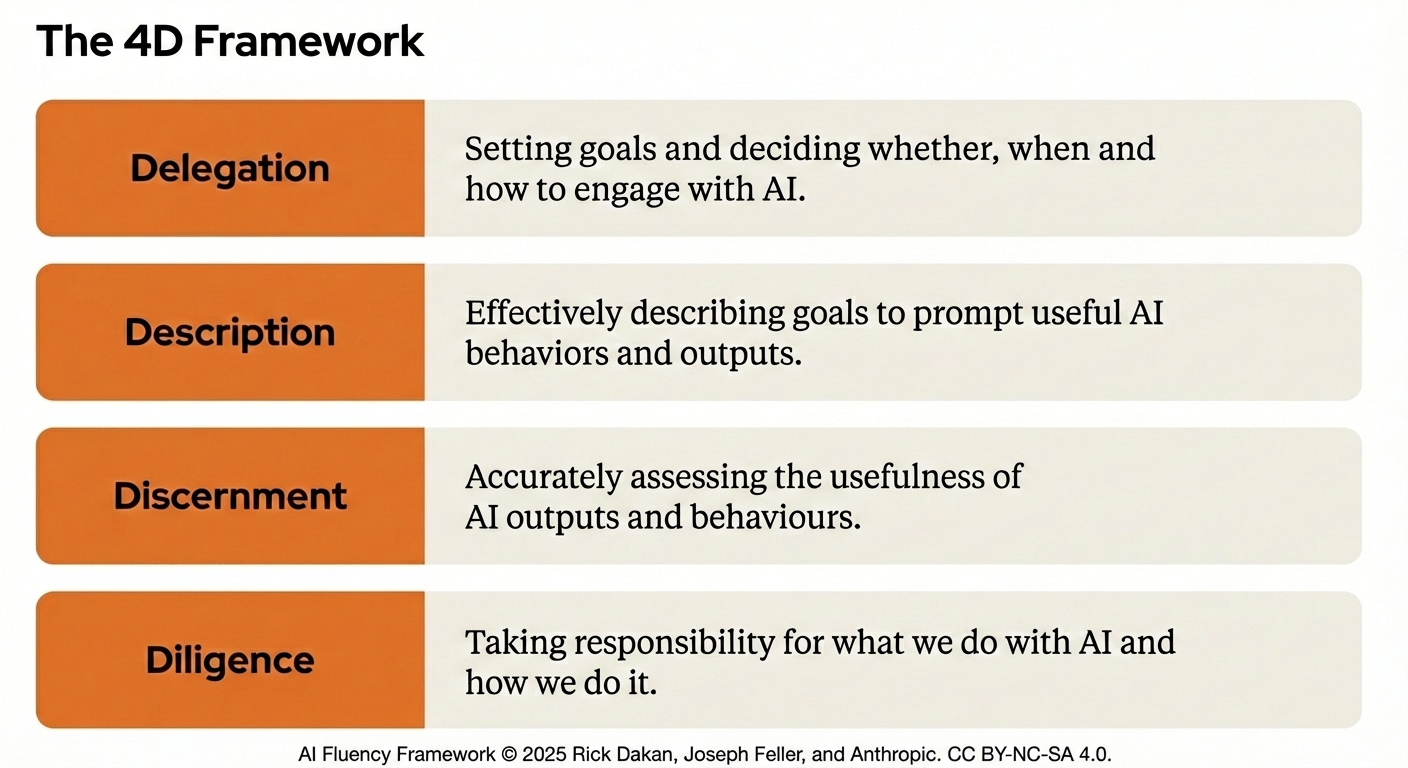
Delegation — setting goals and deciding when to engage
Delegation is about making good decisions before you start interacting with an AI tool. It covers questions like: Is this the right task to bring AI into? What outcome am I actually trying to achieve? What level of AI involvement is appropriate — automation, augmentation, or something else?
This is the competency that prevents the most common AI mistake: reaching for a tool before you have thought clearly about what you need it to do. The practitioner who has strong Delegation skills does not use AI by default — they use it by deliberate choice, with a clear goal in mind.
You will recognise the connection to Lesson 3 immediately: the four lenses for identifying productivity opportunities, and the judgment about which level of the automation spectrum is appropriate for a given task, are both expressions of Delegation.
Description — effectively communicating your goals to AI
Description covers your ability to craft prompts and instructions that produce useful outputs. A well-described goal produces a well-targeted response. A vague or ambiguous description produces a vague or off-target one.
This goes beyond what is usually called "prompt engineering." Description includes understanding your own goals well enough to articulate them clearly — which is harder than it sounds. If you cannot describe precisely what you want and why, the AI cannot help you get there.
Lesson 3 introduced the basics of prompting. Description, as a competency, is what you develop as you practise those basics deliberately over time — noticing what works, refining your approach, and building a repertoire of techniques that you can apply across different tasks and contexts.
Discernment — accurately assessing AI outputs
Discernment is the competency that makes hallucination a manageable risk rather than a catastrophic one. It is the capacity to evaluate what the AI has produced — to assess its accuracy, its relevance, its quality, and whether it is fit for purpose before you act on it.
This is not the same as being suspicious of AI by default. A practitioner with strong Discernment can recognise when an output is excellent and can be used with minimal adjustment, as well as when it contains errors that need correcting or gaps that need filling. The judgement is calibrated, not reflexively negative or uncritically positive.
The human-in-the-loop principle from Lesson 2 is essentially an institutional expression of Discernment — it is designing review into processes because individual Discernment needs structural support, especially in high-stakes contexts.
Diligence — taking responsibility for what you do with AI
Diligence is the ethical and accountability dimension of AI fluency. It covers questions of data handling, organisational policy, transparency about AI use, and responsibility for the consequences of AI-generated outputs that you act upon or share.
A practitioner with strong Diligence asks: Am I using an approved tool? Is there sensitive data in what I am sharing? Am I being transparent about how this output was produced? If this output is wrong or causes harm, do I understand my responsibility?
Diligence is what separates an AI practitioner from someone who uses AI tools uncritically. It is the competency most directly connected to the responsible adoption principles that run through this entire programme.
The three modes of AI interaction
The Framework also introduces a useful way of describing how AI is involved in a task — a categorisation that maps directly onto the automation spectrum from Lesson 1.
Automation — AI executes specific tasks based on human instructions. The human defines the task; the AI carries it out. This maps to the rule-based and workflow automation end of the spectrum.
Augmentation — Humans and AI collaborate as thinking partners. The human retains the lead; AI contributes, suggests, drafts, or analyses. This is the mode most common in GenAI tool use — a human asking a tool to help them think through a problem, draft a document, or explore options.
Agency — Humans configure AI to independently perform future tasks on their behalf. The human sets up the system and the goals; the AI acts with greater autonomy over time. This maps to the AI agent end of the spectrum.
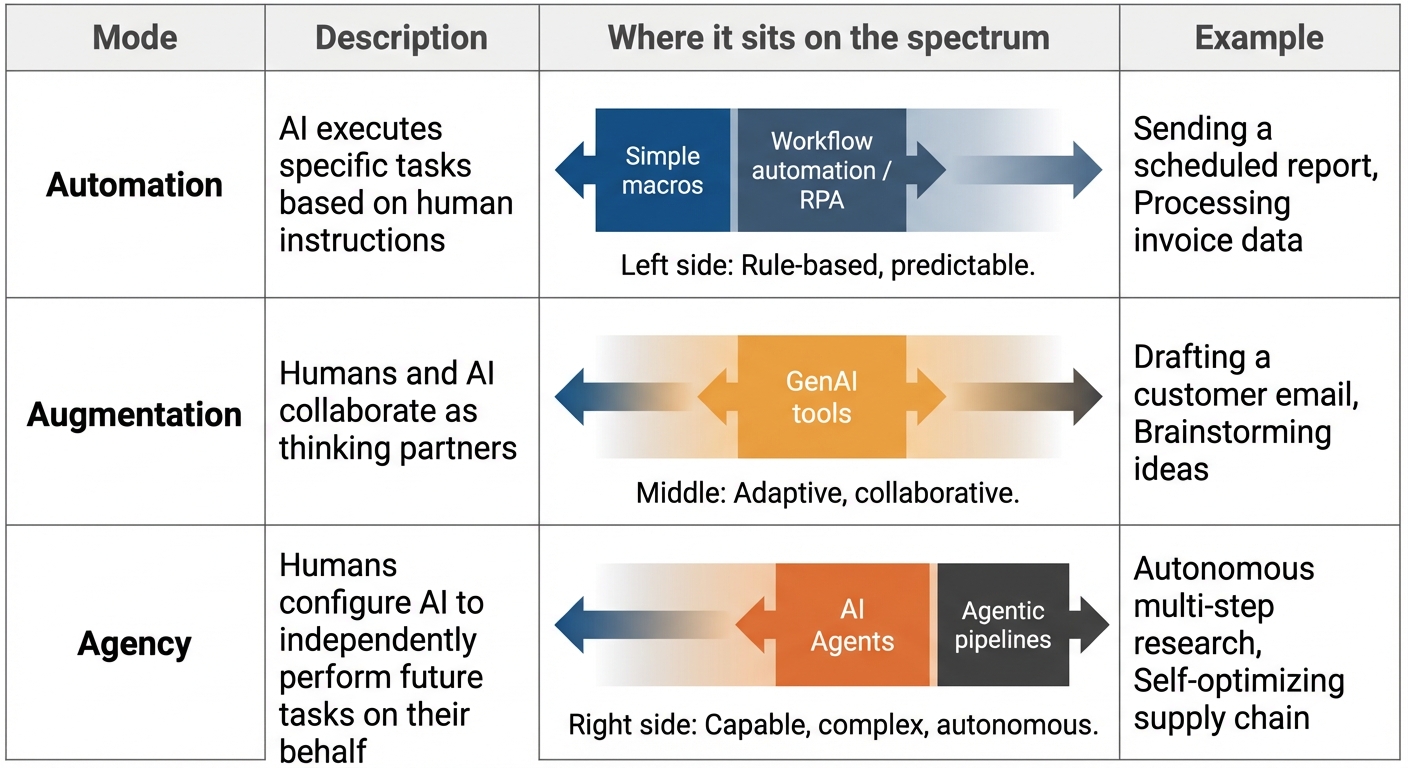
One of the Delegation competency's key tasks is deciding which mode is appropriate for a given situation. Not every task benefits from Agency. Not every task needs Augmentation. Part of developing as a practitioner is building the judgement to make that call well.
Why this matters for your apprenticeship
The 4D Framework is not just a conceptual model — it is a practical lens you will use throughout this programme and beyond.
As you identify automation opportunities, you will be practising Delegation. As you develop your prompting approach, you will be building Description. As you evaluate GenAI outputs for accuracy and fitness for purpose, you will be developing Discernment. As you apply your organisation's policies and take accountability for the outputs you produce and recommend, you will be demonstrating Diligence.
These four competencies together are what it means to be a practitioner rather than just a user of AI tools.

The AI Fluency Framework is explored in depth in a free, structured course from Anthropic Academy. This is optional reading at this stage, but highly recommended — particularly if you want to develop a richer understanding of each competency before you encounter them in applied form later in this programme.
🔗 Anthropic Academy — AI Fluency Framework Foundations https://anthropic.skilljar.com/ai-fluency-framework-foundations
Free to access. No account required to browse. We recommend returning to this course progressively as you move through the programme — each module will bring the 4D competencies to life in a new context.
The AI Fluency Framework was developed by Rick Dakan, Joseph Feller, and Anthropic, and is released under the CC BY-NC-SA 4.0 licence.

Unit 1 — Complete
You have now finished all four lessons of Unit 1. You have built the foundational vocabulary, explored the capabilities and limitations of GenAI, started to look at your own organisation through the lens of opportunity, and been introduced to the framework that will shape how you think about AI practice throughout this programme.
Before your coaching session, make sure you have:
- Completed the Unit 1 Workbook activities (provided separately)
- Submitted your Exploration Log at least 24 hours before your session
- Brought your Workplace AI Landscape Scan notes
- Optionally: explored the Anthropic Academy AI Fluency course and noted any questions it raised for you
What you can now demonstrate
By completing this unit, you have worked towards the following Knowledge, Skills and Behaviours:
| KSB | Description | Where it appears in this unit |
|---|---|---|
| K9 | AI and automation concepts, models and limitations. The impact adoption may have on workplace culture and wellbeing | Lessons 1, 2 and 4 — automation spectrum, LLMs, hallucination, human-in-the-loop, augmentation vs replacement |
| K6 | The importance of designing AI and automation systems that augment rather than replace human work, where feasible | Lesson 2 — the human-in-the-loop principle, AI adoption and people, augmentation framing |
| K5 | Methods to identify opportunities to enhance productivity such as improve processes, reduce waste, increase user or customer satisfaction or optimise outcomes | Lesson 3 — the four lenses for spotting productivity opportunities; Activity 3 — Workplace AI Landscape Scan |
Your coaching session checklist
Before your session, make sure you have:
- ✅ Completed Activity 1 — AI Distinction Challenge (Lesson 1)
- ✅ Completed Activity 2 — Hands-On GenAI Exploration and submitted your Exploration Log at least 24 hours before your session (Lesson 2)
- ✅ Completed Activity 3 — Workplace AI Landscape Scan with notes ready to discuss (Lesson 3)
- ✅ Optionally: started exploring the Anthropic Academy AI Fluency course and noted any questions it raised
Your coach will use your activities and observations from this unit to help you begin identifying the workplace process that will form the foundation of your apprenticeship project.
Level 4 AI & Automation Practitioner | Unit 1 — Lesson 4 of 4 | Version 1.0 AI Fluency Framework © 2025 Rick Dakan, Joseph Feller, and Anthropic. CC BY-NC-SA 4.0.